
10 Best Private AI Platforms for Healthcare: HIPAA-Compliant LLM Solutions (2026)
Compare 10 HIPAA-compliant AI platforms for healthcare including self-hosted options, Prem AI AWS HealthLake, Azure AI Health, and Nuance DAX. Pricing, BAA requirements, and compliance details.
The best HIPAA-compliant AI platforms for healthcare in 2026 are Prem AI, AWS HealthLake with Amazon Bedrock, Microsoft Dragon Copilot (Nuance DAX), Azure AI Health Services, Google Cloud Healthcare AI, Anthropic Claude for Healthcare, OpenAI for Healthcare, John Snow Labs, Hathr.AI, and BastionGPT. Each offers different tradeoffs between data sovereignty, cloud convenience, clinical specialization, and pricing.
92% of healthcare executives are experimenting with or investing in generative AI according to Deloitte's 2025 Global Health Care Executive Outlook. But HIPAA compliance remains the barrier preventing most initiatives from reaching production. A single data breach can result in federal fines up to $1.5 million per violation category, loss of patient trust, and reputational damage that takes years to recover.
The critical question for healthcare AI is not whether to adopt, but how to adopt while protecting Protected Health Information (PHI). For many healthcare organizations, the answer is private AI that keeps data entirely within their control. This guide covers 10 platforms across three categories: self-hosted private solutions, hyperscaler cloud platforms, and specialized healthcare AI tools.
Quick Comparison: HIPAA-Compliant Healthcare AI Platforms
| Platform | Deployment | BAA Required | Pricing | Best For |
|---|---|---|---|---|
| Prem AI | Self-hosted/VPC | N/A (on-premise) | Enterprise pricing | Complete data sovereignty, regulated industries |
| AWS HealthLake + Bedrock | Cloud/VPC | Yes | Usage-based | Custom healthcare AI applications |
| Microsoft Dragon Copilot | Cloud | Yes | ~$600-800/provider/month | Clinical documentation, large health systems |
| Azure AI Health Services | Cloud | Yes | Usage-based | Microsoft ecosystem organizations |
| Google Cloud Healthcare AI | Cloud | Yes | Usage-based | Google Workspace healthcare organizations |
| OpenAI for Healthcare | Cloud | Yes (Enterprise) | Enterprise pricing | GPT-5.2 powered clinical workflows |
| Claude for Healthcare | Cloud | Yes (Enterprise) | Enterprise pricing | Prior authorization, clinical reasoning |
| John Snow Labs | Cloud/Self-hosted | Yes | Enterprise pricing | Medical NLP, biomedical LLMs |
| Hathr.AI | Cloud (GovCloud) | Yes | Usage-based | Government healthcare, FedRAMP High |
| BastionGPT | Cloud | Yes | From $39/month | Small practices, mental health |
Understanding HIPAA Compliance for AI
Before evaluating platforms, understand what HIPAA compliance actually requires for AI systems.
Business Associate Agreement (BAA): Any AI vendor processing PHI must sign a BAA with your organization. This contract legally binds the vendor to HIPAA standards including data protection, breach notification, and subcontractor obligations. Without a signed BAA, using any AI system with patient data violates HIPAA.
The self-hosted exception: When AI runs entirely on your infrastructure and PHI never leaves your environment, no BAA is required with an external vendor. You remain the sole custodian of patient data. This is why self-hosted platforms like Prem AI appeal to healthcare organizations seeking the simplest compliance path.
HIPAA-eligible vs HIPAA-compliant: A service that is "HIPAA-eligible" has the necessary security features and the vendor is willing to sign a BAA. However, using an eligible service does not automatically make your implementation compliant. You remain responsible for proper configuration, access controls, and usage policies. Gartner estimated that through 2025, 99% of cloud security failures would be the customer's fault.
Key technical requirements:
- Encryption at rest and in transit (AES-256 standard)
- Access controls and audit logging
- PHI isolation from model training
- Breach detection and notification systems
- Minimum necessary data access principles
AI-specific concerns:
- Model memorization of PHI during training
- Output containing PHI in responses to other users
- Data retention policies for conversations
- Third-party subprocessor access to PHI
Self-Hosted Private AI Platforms
For healthcare organizations requiring maximum data control, self-hosted AI eliminates external data transmission entirely. PHI stays within your infrastructure. No BAA complexity with external vendors. Complete audit control.
1. Prem AI
Prem AI provides self-hosted AI infrastructure for organizations requiring complete data sovereignty. The platform runs entirely within your environment with zero external data transmission.
Privacy architecture:
- Zero data retention by design
- Cryptographic proofs for every interaction
- Hardware-signed attestations for privacy auditing
- Stateless architecture
- Air-gapped deployment support
- Swiss jurisdiction under Federal Act on Data Protection (FADP)
Deployment options: On-premises servers, your VPC (AWS, Azure, GCP), or dedicated infrastructure. Data never leaves your control regardless of deployment model.
Healthcare capabilities:
- Fine-tune models on proprietary clinical data without external exposure
- Build RAG applications over medical records
- Deploy multiple specialized models for different clinical use cases
- Sub-100ms inference latency for real-time applications
- Support for 30+ base models including Mistral, Llama, Qwen, Gemma
Compliance: SOC 2 Type II, GDPR, and HIPAA compliant. Swiss data jurisdiction provides additional privacy protections beyond US requirements. Because PHI never leaves your infrastructure, BAA complexity with external vendors is eliminated entirely.
Fine-tuning for healthcare: Prem's autonomous fine-tuning system enables healthcare organizations to train models on their specific clinical data, terminology, and workflows. A hospital can fine-tune on their documentation patterns. A specialty practice can train on their diagnostic criteria. The resulting models understand your clinical context without your data ever leaving your systems.
Integration: OpenAI-compatible APIs enable drop-in replacement for existing applications. SDKs available for Python and JavaScript. Kubernetes operator for enterprise deployment.
Pricing: Enterprise pricing through sales. Available on AWS Marketplace for simplified procurement.
Best for:
- Healthcare organizations that cannot send PHI to external cloud services under any circumstances
- Institutions requiring air-gapped deployments (government healthcare, military medical)
- Organizations wanting to fine-tune models on proprietary clinical data
- Health systems prioritizing Swiss/EU data jurisdiction over US cloud providers
Limitations: Requires infrastructure management and ML/DevOps capabilities. Not a turnkey clinical documentation solution like Nuance DAX. Best suited for organizations with technical teams or implementation partners.
Learn more about Prem's healthcare AI capabilities
2. John Snow Labs
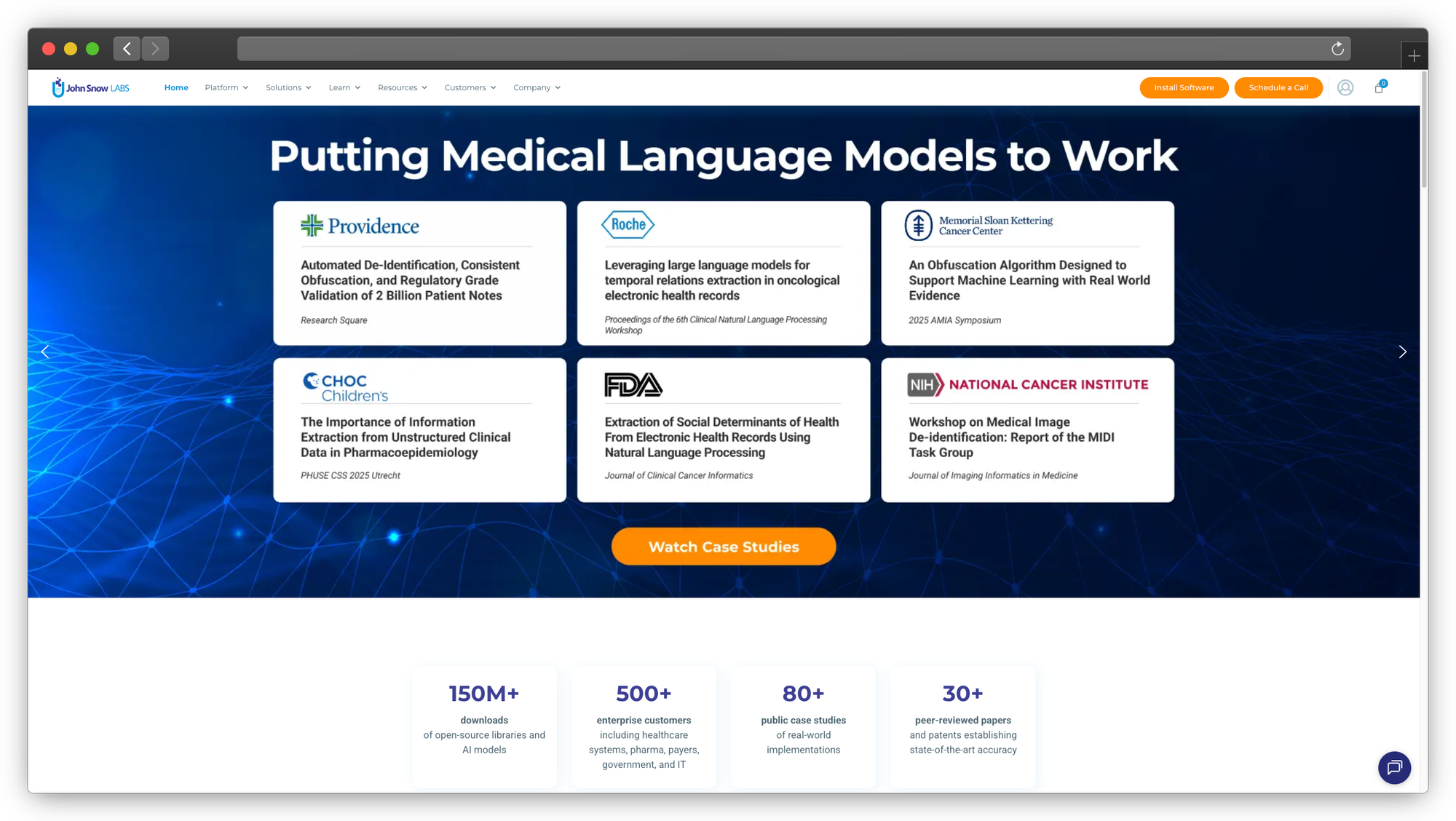
John Snow Labs provides healthcare-specific NLP and medical LLMs with both cloud and self-hosted deployment options.
What it does: Offers pre-trained medical language models, healthcare NLP libraries, and tools for building clinical AI applications with a focus on biomedical accuracy.
Products:
- Medical LLMs: Domain-specific models trained on clinical literature
- Healthcare NLP: Spark NLP library with medical entity recognition
- Generative AI Lab: No-code platform for healthcare AI development
- Medical Vision-Language Models: Radiology image interpretation
Deployment: Available through AWS Marketplace (SageMaker JumpStart) or self-hosted deployment. Supports air-gapped environments for maximum security.
Compliance: HIPAA-compliant with BAA available for cloud deployment. Provides de-identification pipelines for DICOM images and clinical text.
Pricing: Enterprise pricing. AWS Marketplace availability for simpler procurement.
Best for: Organizations building custom medical AI applications. Teams needing specialized medical NLP rather than general-purpose LLMs.
Limitations: Developer-focused platform. Requires ML expertise for implementation.
3. Hathr.AI
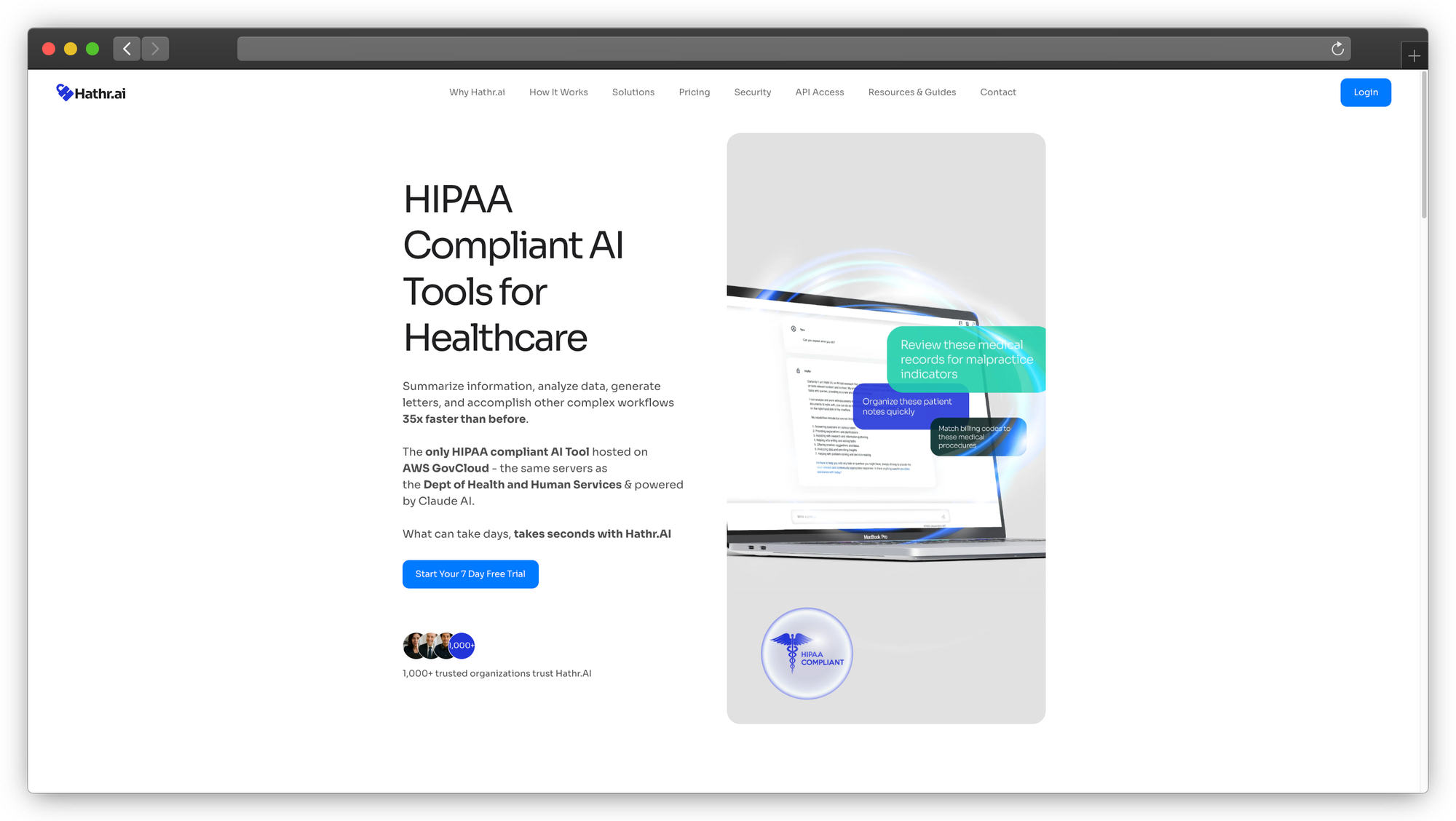
Hathr.AI provides HIPAA-compliant AI hosted on AWS GovCloud, the same infrastructure used by the Department of Health and Human Services.
What it does: Offers Claude-powered AI (not ChatGPT) for healthcare document processing, research, and analysis in a FedRAMP High environment.
Features:
- 500,000+ word document handling
- Medical record summarization
- Proposal and RFP response assistance
- 100% private processing within GovCloud
- FedRAMP High certified environment
Compliance: HIPAA-compliant with BAA available. Hosted on AWS GovCloud provides government-level security exceeding standard commercial cloud.
Pricing: Usage-based. Contact for specific pricing.
Best for: Government healthcare organizations, VA hospitals, DoD medical facilities, contractors requiring FedRAMP compliance alongside HIPAA.
Limitations: Focused on document processing rather than clinical workflows. Limited EHR integration.
Hyperscaler Cloud Platforms
For organizations comfortable with cloud deployment and proper BAA coverage, hyperscalers offer mature healthcare AI infrastructure.
4. AWS HealthLake + Amazon Bedrock
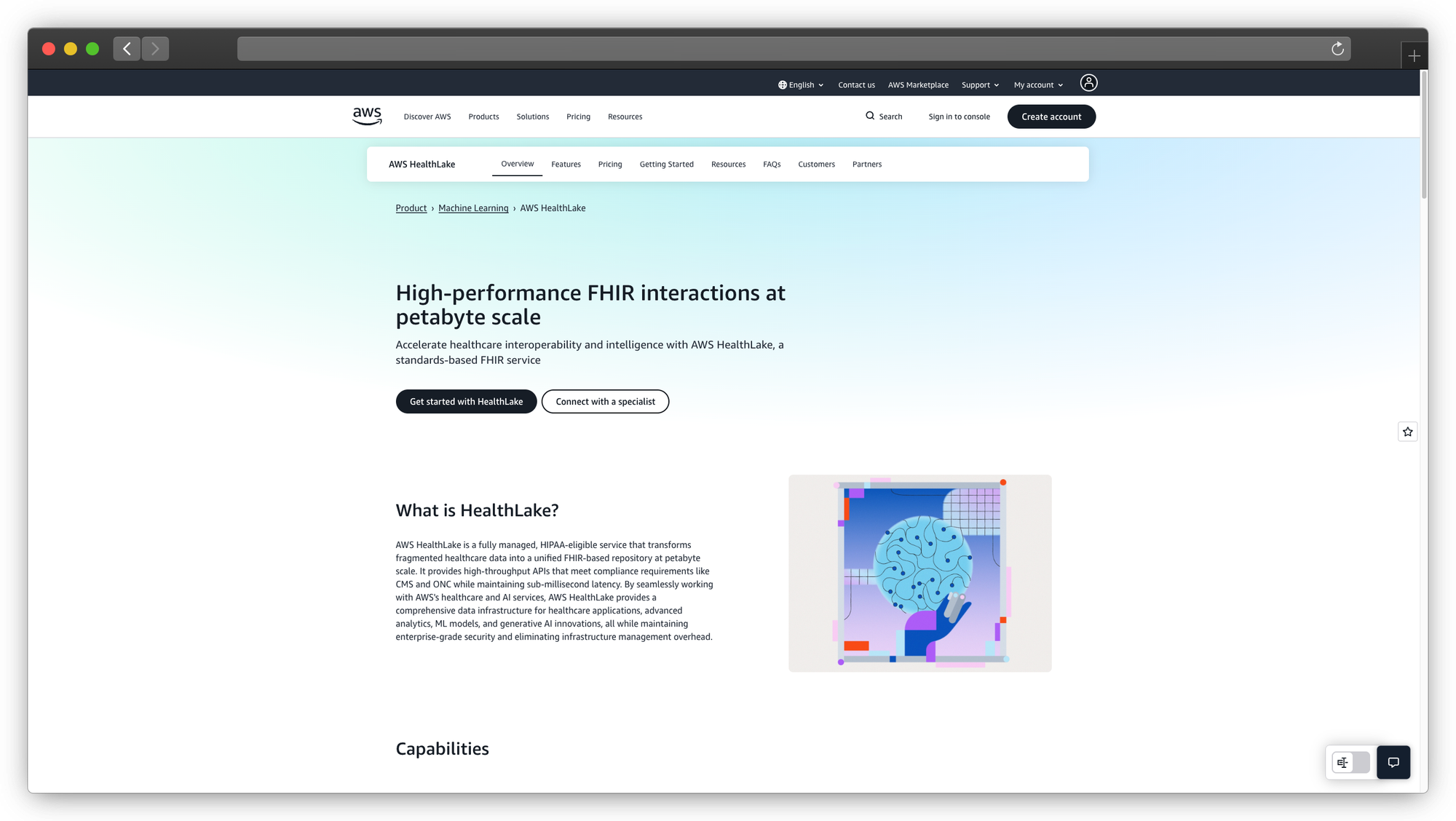
AWS provides infrastructure for building HIPAA-compliant healthcare AI applications rather than turnkey solutions.
What it does: HealthLake is a HIPAA-eligible data lake for storing, transforming, and querying healthcare data using FHIR standards. Amazon Bedrock provides access to foundation models (Claude, Llama, Mistral, Amazon Titan) for building AI applications.
Components:
- HealthLake: FHIR-based data store with real-time indexing, petabyte scale
- HealthScribe: Automated clinical documentation from conversations
- HealthOmics: Genomics and multiomics data analysis
- Comprehend Medical: Medical NLP for extracting entities from clinical text
- SageMaker: Custom model training and deployment
New capability (2026): HealthLake MCP Server provides natural language interfaces to FHIR resources, enabling AI agents to query patient data conversationally while maintaining compliance.
Compliance: All healthcare services are HIPAA-eligible with BAA available. SOC 1/2/3, ISO 27001, HITRUST CSF certified. Supports VPC deployment for additional isolation.
Pricing: Usage-based across all services. HealthLake charges per GB stored and queries processed. Bedrock charges per token for inference. No minimum commitments for most services.
Best for: Developer teams building custom healthcare AI applications. Organizations wanting full control over AI architecture while leveraging AWS compliance infrastructure.
Limitations: Requires significant development effort. Not a turnkey solution. Healthcare expertise needed for FHIR data modeling and compliance configuration.
5. Microsoft Dragon Copilot (Nuance DAX)
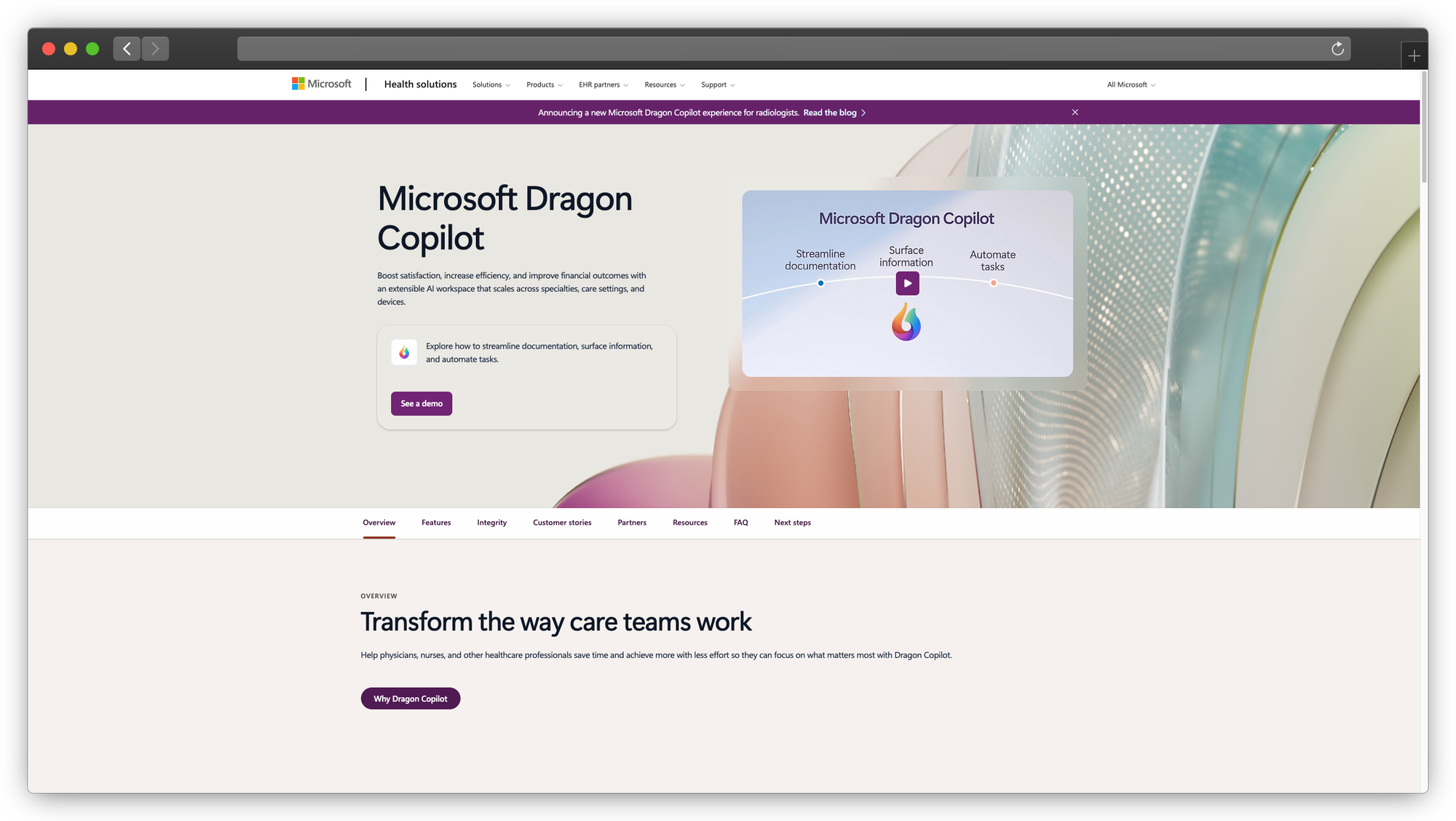
Microsoft's Dragon Copilot is the market leader for ambient clinical documentation, used by thousands of clinicians across the US, Canada, UK, and expanding to Europe.
What it does: Captures clinician-patient conversations and automatically generates specialty-specific clinical notes. The AI listens during encounters and produces structured documentation (HPI, ROS, PE, A/P) within seconds of visit completion.
Clinical capabilities:
- Ambient documentation across 50+ medical specialties
- Order suggestions embedded in Epic workflows
- After-visit summaries and referral letter generation
- Multi-party conversation capture
- Spanish language support without translator
- Dragon Copilot for nurses (GA December 2025)
Integration: Deep EHR integration with Epic (embedded in Haiku), plus 200+ EHR systems through Dragon Medical One. Notes appear automatically in correct fields without provider action.
Compliance: HITRUST CSF certified, HIPAA-compliant with BAA available. Data processed in Microsoft Azure with enterprise-grade security.
Outcomes data:
- Northwestern Medicine: 24% less time drafting notes, 11.3 additional patients seen
- 50% reduction in documentation time
- 70% decrease in reported burnout
- 112% ROI per Forrester TEI study
Pricing: Approximately $600-800 per provider per month with 1-3 year contracts. Enterprise pricing varies by health system size. No public pricing page.
Best for: Large health systems on Epic wanting zero-click documentation workflows. Organizations prioritizing proven clinical outcomes over data sovereignty concerns.
Limitations: Most expensive option. iOS only for mobile. Requires enterprise IT for setup. Transcripts only, no audio storage. Not practical for small practices. PHI processed in Microsoft cloud.
6. Azure AI Health Services
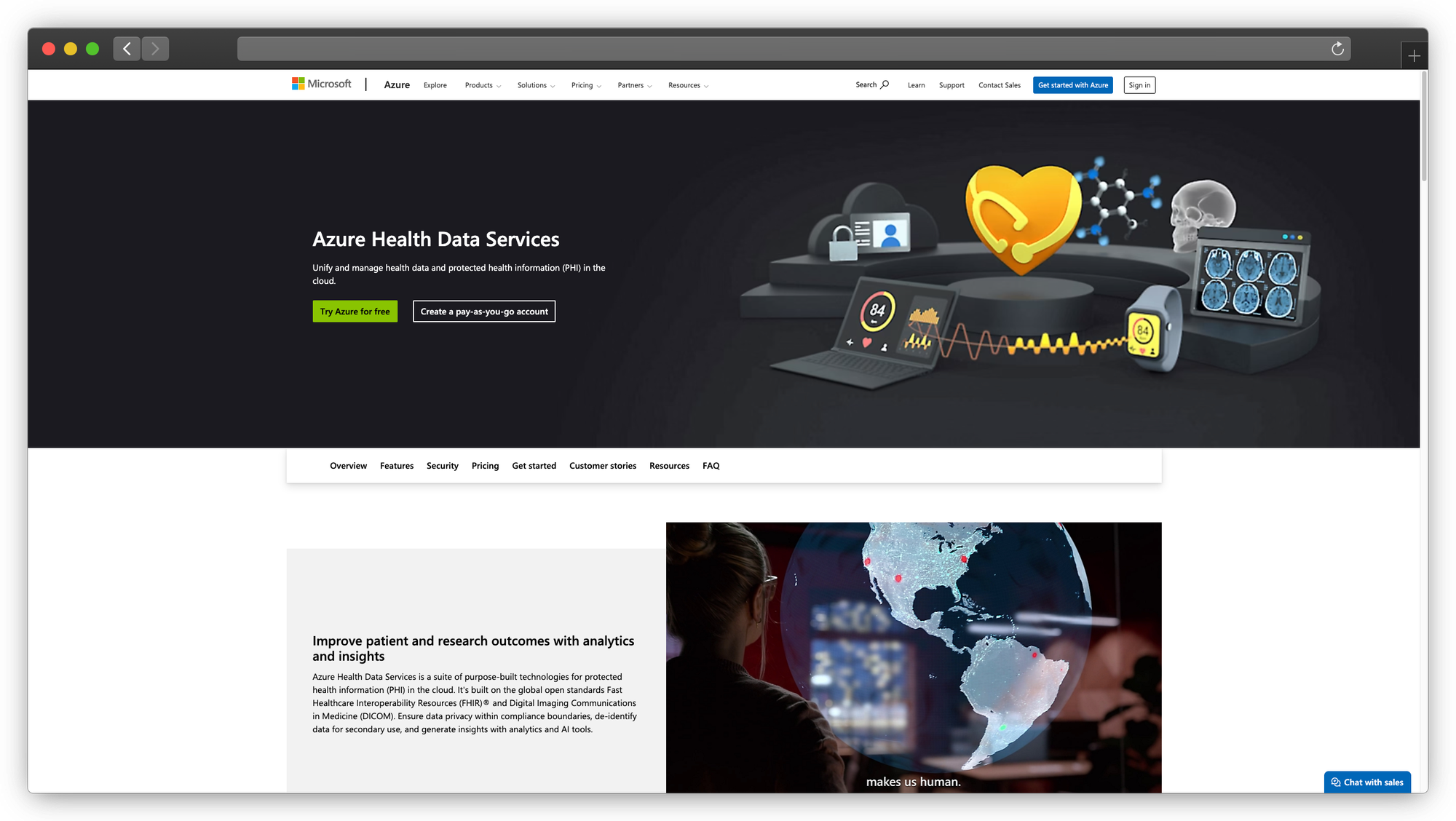
Microsoft's healthcare AI stack integrated with the broader Azure ecosystem.
What it does: Provides pre-built healthcare AI services plus infrastructure for custom development, all within Microsoft's compliance framework.
Components:
- Azure Health Data Services: FHIR, DICOM, and MedTech data services
- Text Analytics for Health: Medical NLP and entity extraction
- Azure AI Document Intelligence: Medical document processing
- Azure OpenAI Service: GPT-4 and GPT-5 access with enterprise security
- Microsoft Fabric: Healthcare data analytics
Compliance: HIPAA BAA available, HITRUST CSF certified, SOC 2 Type II audited. Integration with Microsoft Purview for data governance.
Pricing: Usage-based across services. Azure OpenAI charges per 1K tokens. Health Data Services charges per API call and storage.
Best for: Organizations already invested in Microsoft 365 and Azure. Health systems using Microsoft Teams for clinical collaboration.
Limitations: Ecosystem lock-in. Complex pricing across multiple services. Requires Azure expertise for implementation.
7. Google Cloud Healthcare AI
Google's healthcare offerings combining Cloud Healthcare API with Vertex AI.
What it does: Provides FHIR/HL7/DICOM data management plus AI capabilities including medical imaging analysis, clinical NLP, and custom model development.
Components:
- Cloud Healthcare API: FHIR, HL7v2, DICOM data stores
- Healthcare Natural Language API: Medical entity extraction
- Vertex AI: Custom model training and deployment
- Medical Imaging Suite: Radiology AI tools
- Google Agentspace: Enterprise search for healthcare (on-premise option coming Q3 2025)
Compliance: HIPAA BAA available, HITRUST certified, SOC 2 audited. Supports data residency controls.
Pricing: Usage-based. Healthcare API charges per operation and storage. Vertex AI charges per compute hour and prediction.
Best for: Google Workspace healthcare organizations. Teams needing medical imaging AI capabilities.
Limitations: Smaller healthcare customer base than AWS or Azure. Agentspace on-premise still in preview.
Specialized Healthcare AI Tools
8. OpenAI for Healthcare (ChatGPT for Healthcare)
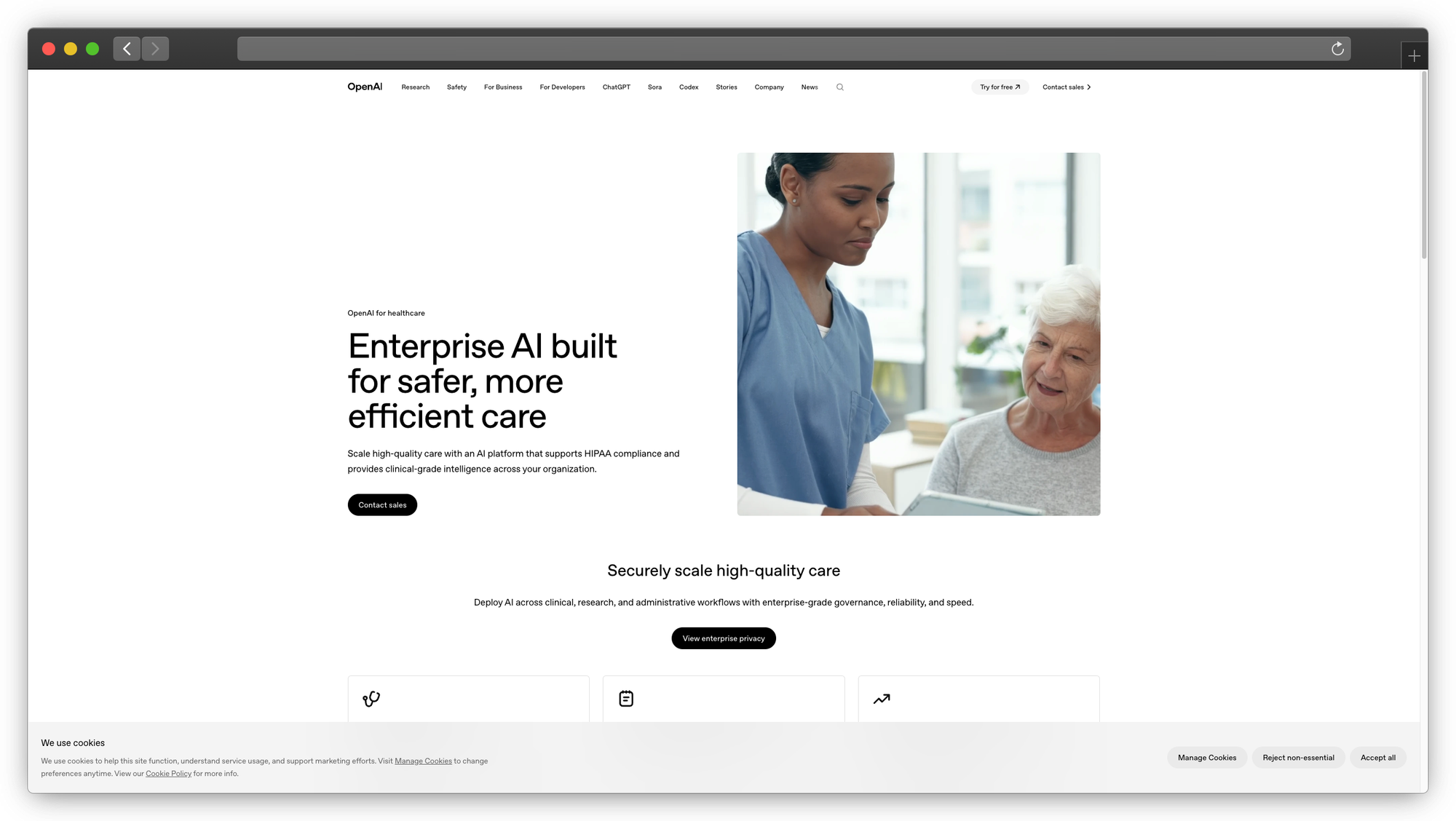
OpenAI launched ChatGPT for Healthcare in January 2026 as an enterprise-grade product specifically for regulated healthcare environments.
What it does: Provides GPT-5.2 models optimized for clinical accuracy, with evidence retrieval from peer-reviewed research and public health guidance. Includes citation support for clinical decisions.
Capabilities:
- Clinical documentation synthesis
- Medical evidence retrieval with transparent citations
- Patient-facing education material adaptation
- Administrative workflow automation
- Multi-modal analysis (documents, images)
Important distinction: ChatGPT for Healthcare is different from ChatGPT Health (consumer wellness product). Only the enterprise healthcare product supports HIPAA compliance. Consumer ChatGPT cannot be made HIPAA compliant under any circumstances.
Compliance: BAA available for enterprise API customers. Content shared with ChatGPT for Healthcare is not used to train models. Customer-managed encryption keys, audit logs, and data residency options available.
Pricing: Enterprise pricing through sales. API customers can apply for BAA access.
Best for: Organizations wanting GPT-5.2 capabilities with healthcare-specific optimizations and citation support.
Limitations: Requires enterprise contract. Configuration and governance responsibility remains with healthcare organization. PHI processed in OpenAI infrastructure.
9. Anthropic Claude for Healthcare
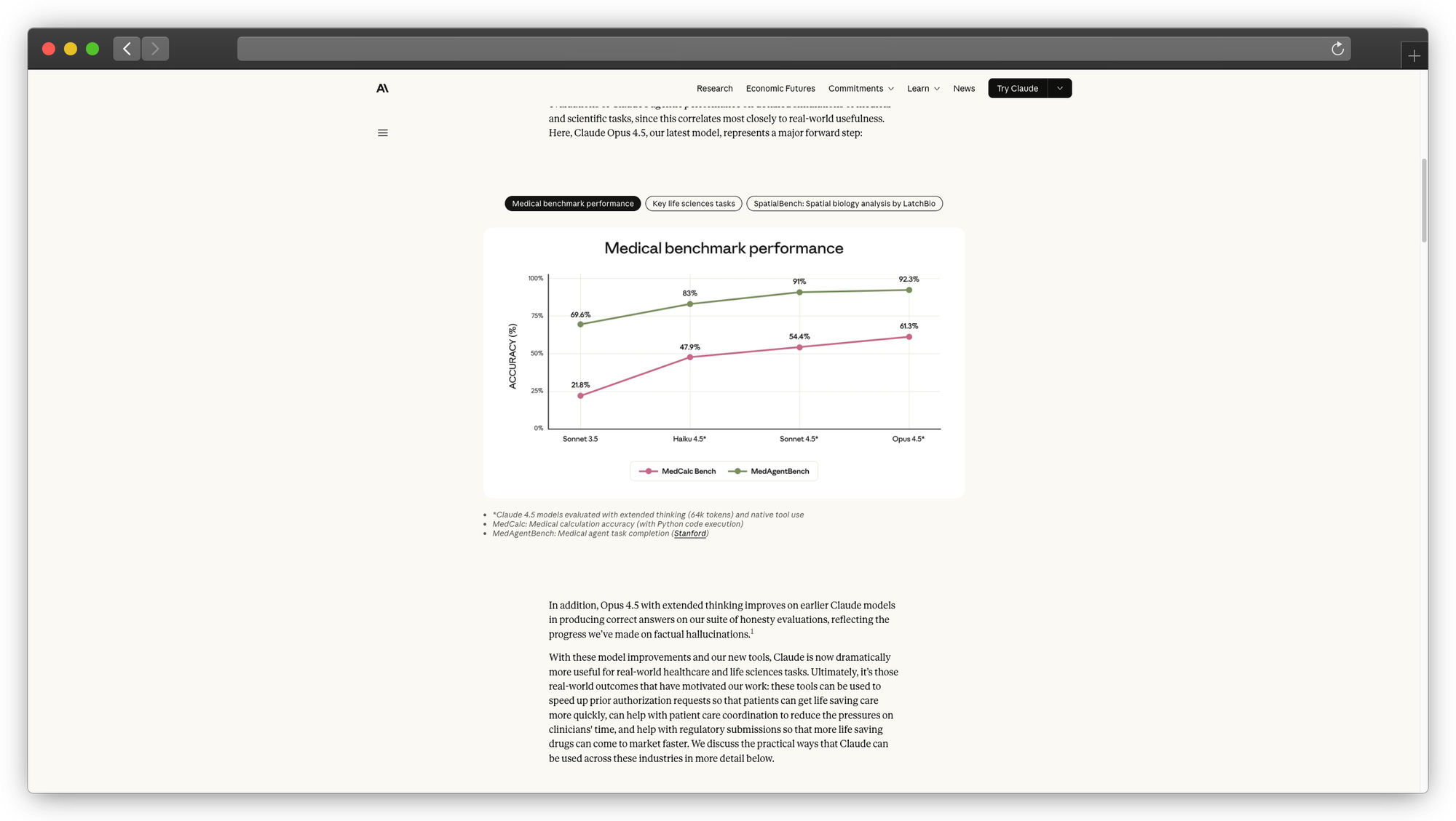
Anthropic expanded Claude for Enterprise with healthcare-specific tools in 2026.
What it does: Provides Claude 4 models with healthcare connectors, FHIR development skills, and sample workflows for clinical tasks like prior authorization review.
Healthcare features:
- PubMed connector for real-time literature access
- FHIR development agent skill
- Prior authorization review template
- Claims appeals support
- Care coordination workflows
Clinical performance: Claude Opus 4.5 shows improved performance on medical benchmarks and reduced hallucinations on factual medical questions compared to earlier versions.
Compliance: Claude for Enterprise is HIPAA-ready with BAA available. SOC 2 Type II certified.
Pricing: Enterprise pricing through sales.
Best for: Healthcare organizations prioritizing AI reasoning capabilities and factual accuracy. Teams building agentic workflows for administrative tasks.
Limitations: Enterprise-only for HIPAA use. Requires integration work for clinical workflows.
10. BastionGPT
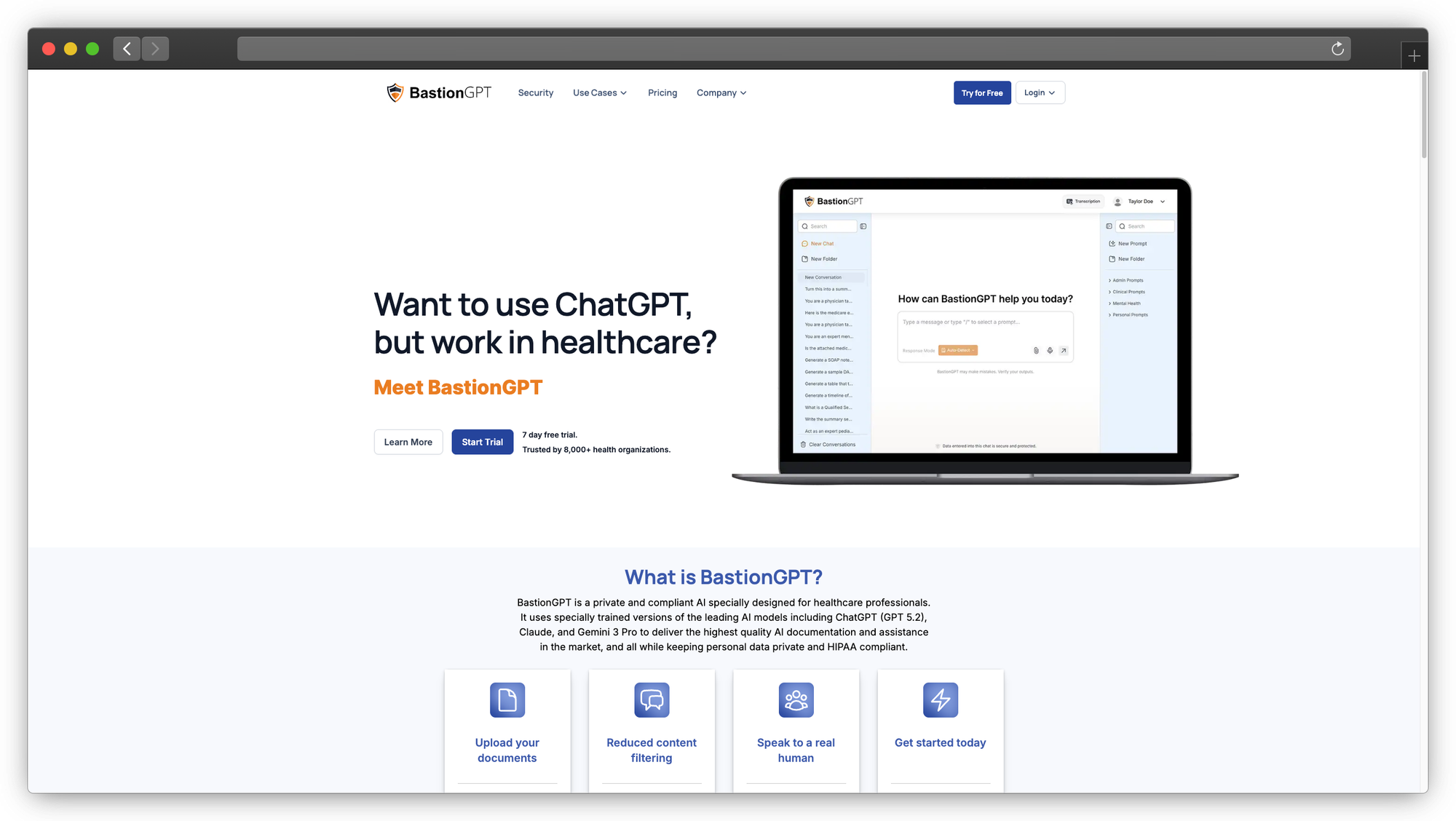
BastionGPT provides HIPAA-compliant access to leading AI models for healthcare professionals, particularly mental health practitioners.
What it does: Wraps GPT-5.2, Claude, and Gemini 3 Pro in a HIPAA-compliant interface with healthcare-specific optimizations. Handles document analysis up to 150,000 words.
Features:
- Access to multiple AI models (ChatGPT, Claude, Gemini)
- Document summarization and analysis
- Healthcare-specific prompt optimization
- Supports adult health topics without content blocking
- Voice and video call support
Compliance: HIPAA-compliant with BAA included in all plans. Microsoft Partner with HIPAA-compliant model access. Reviewed by American Psychiatric Association for mental health use.
Pricing: Starts at $39/month. Multiple tiers available. All plans include BAA.
Best for: Small practices, mental health professionals, solo practitioners wanting ChatGPT-like capabilities with HIPAA compliance at accessible pricing.
Limitations: Smaller provider than hyperscalers. Limited EHR integration.
How to Evaluate Healthcare AI Vendors
When selecting a HIPAA-compliant AI platform, assess these factors:
Data sovereignty first:
- Can PHI stay entirely within your infrastructure?
- If cloud-based, where is data processed and stored?
- Does data ever leave your jurisdiction?
- Is air-gapped deployment available if needed?
Compliance verification:
- Does the vendor sign a BAA? Request a copy before evaluation.
- What third-party certifications exist? (SOC 2 Type II, HITRUST CSF, ISO 27001)
- Does customer data train their models? The answer must be no.
- Does data leave your dedicated instance? Verify isolation architecture.
Technical requirements:
- Is PHI encrypted at rest and in transit?
- Are access controls and audit trails available?
- Can user permissions be tightly controlled?
- Does the vendor provide breach alerts and response tools?
Total cost of ownership:
- Per-user vs per-encounter vs usage-based pricing
- Implementation and training costs
- Infrastructure costs for self-hosted options
- Contract length and termination terms
Frequently Asked Questions
Is ChatGPT HIPAA compliant?
Standard ChatGPT (consumer product) is not HIPAA compliant and cannot be made compliant. OpenAI's ChatGPT for Healthcare (enterprise product launched January 2026) can support HIPAA compliance when properly configured with a BAA. The API also supports BAA for eligible enterprise customers. Never input PHI into consumer ChatGPT, ChatGPT Plus, or ChatGPT Health (consumer wellness product).
What is the most private option for healthcare AI?
Self-hosted platforms like Prem AI provide maximum privacy because PHI never leaves your infrastructure. No external BAA is required when you are the sole data custodian. This eliminates concerns about cloud provider access, subprocessor chains, and jurisdiction issues. The tradeoff is requiring infrastructure management capabilities.
Can I use Claude or GPT-4 with patient data?
Yes, through enterprise products with signed BAAs. Claude for Enterprise and OpenAI for Healthcare both support HIPAA-compliant use. You cannot use consumer versions of these products with PHI. Enterprise deployment requires proper configuration, access controls, and governance beyond just signing the BAA.
What does a BAA cost for healthcare AI?
Most major platforms include BAA at no additional cost as part of enterprise agreements. AWS, Azure, and Google Cloud provide BAAs for eligible services. Smaller vendors like BastionGPT include BAA in all subscription tiers. The BAA itself is free; you pay for the underlying service. Self-hosted options like Prem AI eliminate BAA requirements entirely.
Do I need HIPAA compliance if I de-identify data before using AI?
If data is properly de-identified according to HIPAA Safe Harbor or Expert Determination standards, it is no longer PHI and HIPAA does not apply. However, de-identification must be thorough. AI models can sometimes re-identify patients from combinations of data points. When in doubt, treat data as PHI and use compliant systems.
Conclusion
Healthcare AI adoption is accelerating, but compliance requirements make platform selection critical. The right choice depends on your data sovereignty requirements, technical capabilities, and risk tolerance.
For organizations requiring maximum data control, Prem AI enables self-hosted deployment where PHI never leaves your infrastructure. This approach eliminates external BAA complexity and provides complete audit control. Swiss jurisdiction adds privacy protections beyond US requirements. The tradeoff is requiring infrastructure and ML capabilities.
For large health systems prioritizing proven clinical documentation outcomes, Microsoft Dragon Copilot (Nuance DAX) offers the most mature ambient documentation solution with extensive outcomes data. The $600-800 per provider monthly cost delivers measurable ROI through time savings.
For organizations building custom applications, AWS HealthLake and Amazon Bedrock provide flexible infrastructure with comprehensive HIPAA coverage. Azure AI Health Services makes sense for Microsoft-centric organizations.
For smaller practices or those wanting simpler deployment, BastionGPT offers accessible entry at $39/month with BAA included.
Evaluate vendors based on where your data actually goes, not marketing claims. Verify compliance certifications independently. Remember that signing a BAA is necessary but not sufficient for HIPAA compliance with cloud vendors. And for the most sensitive use cases, consider whether self-hosted deployment eliminates risk that no BAA can fully address.