
13 Best OpenAI Alternatives for Enterprise AI in 2026
Compare enterprise OpenAI alternatives from self-hosted LLMs to API platforms. Honest trade-offs on Claude, Gemini, Llama, Mistral, Groq, and more.
OpenAI set the standard for enterprise AI. GPT-4 is capable. The API is polished. Microsoft's backing adds credibility.
But that dominance creates problems.
Vendor lock-in. Data residency concerns. Pricing that scales faster than your budget. For regulated industries, the question of where your data actually lives keeps legal teams awake.
67% of enterprises cite data privacy as their primary barrier to AI adoption. Another 45% worry about cost unpredictability with usage-based pricing.
This isn't about finding a "better" model. It's about finding the right fit for how your organization operates.
Here are thirteen OpenAI alternatives, organized from full data sovereignty to API-first options. Each has trade-offs. We'll be honest about them.
Quick Comparison
1. Prem AI

The full-sovereignty option for enterprises that need to own everything.
Prem AI takes a different approach than typical ChatGPT alternatives. Instead of accessing models through an API you don't control, you deploy custom AI infrastructure within your own environment. Swiss-based, SOC 2 certified, built for organizations where "trust us" isn't enough.
Why enterprises pick it:
- Fine-tune models on proprietary data without it leaving your infrastructure
- Sub-100ms inference latency with 99.98% uptime
- Cryptographic verification for every interaction
- Deploy on AWS VPC, on-premise, or hybrid configurations
Deployment & Compliance:
Swiss jurisdiction under FADP provides regulatory advantages for European enterprises. GDPR, HIPAA, and SOC 2 compliant. Your data never touches external servers unless you configure it to.
The Prem Studio platform handles the full lifecycle: dataset preparation with automatic PII redaction, fine-tuning with 30+ base models, evaluation, and one-click deployment.
Pricing:
Usage-based through AWS Marketplace. Enterprise tier with custom support and reserved compute. Volume discounts available. Contact sales for specific pricing.
Best for: Regulated industries (finance, healthcare, government) where data sovereignty isn't optional. Organizations building specialized reasoning models that need to stay proprietary.
The catch: Higher upfront complexity than pure API solutions. You're responsible for infrastructure decisions. Teams without ML experience may need the autonomous fine-tuning system to bridge the gap.
2. Anthropic Claude
Strong reasoning. Safety alignment. Enterprise compliance built-in.
Claude has become the go-to for enterprises prioritizing reasoning quality and responsible AI deployment. Claude 4.5 Opus broke 80% on SWE-bench. The constitutional AI approach makes outputs more predictable.
Why enterprises pick it:
- 200K token context window handles entire codebases
- Claude Code integration for development workflows
- Compliance API for real-time usage monitoring
- Constitutional AI reduces hallucination rates
Deployment & Compliance:
Available through Anthropic's API, AWS Bedrock, and Google Cloud. SOC 2 Type II certified. Enterprise plans include SSO, domain capture, and granular admin controls. Customer prompts are not used for model training.
Pricing:
- Opus 4.5: $5/M input tokens, $25/M output tokens
- Sonnet 4.5: $3/M input, $15/M output
- Haiku 4.5: $1/M input, $5/M output
- Enterprise: Custom pricing with seat minimums
Best for: Enterprises needing strong reasoning capabilities with governance controls. Legal, compliance, and customer service teams where accuracy matters.
The catch: Usage limits cause friction. Developers report hitting caps faster than expected. Enterprise pricing requires significant seat commitments. No live chat support on standard plans.
3. Google Gemini
Deep Workspace integration. Strong multimodal. Google ecosystem lock-in.
If your organization runs on Google Workspace, Gemini removes friction other providers can't match. Native integration with Docs, Sheets, Gmail, and Drive means AI assistance without context-switching. The 1-million-token context window handles documents that break other models.
Why enterprises pick it:
- 1M token context window for massive document analysis
- Native Workspace integration (Docs, Sheets, Gmail, Drive)
- Gemini Code Assist for development workflows
- Strong multimodal capabilities (text, image, video)
Deployment & Compliance:
Google Cloud only. Enterprise data protections apply: no training on your data, DLP controls, data region policies inherited from Workspace. SOC 2, ISO 27001, HIPAA BAA available.
Pricing:
- Gemini for Workspace: Bundled with Enterprise Workspace plans
- API: Gemini 2.5 Pro at ~$7/M input, $21/M output
- Usage caps vary by tier
Best for: Google Workspace shops. Teams analyzing long documents or needing Calendar/Drive integration.
The catch: Integrations outside Google's ecosystem feel limited. Users report inconsistent performance during peak times. Hallucination rates on factual queries remain a concern. If you need multi-cloud flexibility, you won't find it here.
4. Meta Llama
Open-source flexibility. Run anywhere. No API costs if you self-host.
Llama flipped the script on enterprise AI. Instead of paying per token, you download the weights and run them wherever you want. Llama 4 introduced native multimodal support and a mixture-of-experts architecture.
Why enterprises pick it:
- Open weights under community license, free for most commercial use
- 128K context window (Llama 3.1) to 10M tokens (Llama 4)
- Run on-premise, in your VPC, on edge devices
- Fine-tune freely without licensing negotiations
- 47% reduction in total cost of ownership vs. closed APIs
Deployment & Compliance:
You control the deployment. Options include self-hosted LLM infrastructure, major cloud providers, or edge devices. Compliance depends on your implementation. No vendor agreements needed.
Pricing:
Free weights. You pay for compute. A 70B model needs ~140GB VRAM (two A100s). Smaller variants (8B, 13B) run on consumer hardware.
Best for: Organizations with ML engineering capacity. High-volume workloads where API costs compound. Air-gapped deployments. Teams that want complete control over their generative AI stack.
The catch: You own the infrastructure burden. Security vulnerabilities have been reported (CVE-2024-50050). Smaller variants limit reasoning depth. Requires ML ops expertise your team may not have.
5. Mistral AI

European sovereignty. Open-weight models. Strong code generation.
Paris-based Mistral offers both open-weight models and commercial API access. Valued at $6.2B as of late 2024, they're the European answer to US-dominated AI infrastructure.
Why enterprises pick it:
- Mistral Large 2 rivals GPT-4 on benchmarks
- Codestral specialized for code generation
- Open-weight models (7B, 8x7B, 8x22B) for local deployment
- European data residency and GDPR by design
- Models run on consumer hardware (Mistral 7B needs ~16GB VRAM)
Deployment & Compliance:
API hosted in European data centers. Open-weight models deploy anywhere. SOC 2 Type II certified. La Plateforme enterprise tier includes dedicated instances and premium support.
Pricing:
- Mistral Large: ~$2/M input, $6/M output
- Codestral: ~$0.20/M input, $0.60/M output
- Open models: Free weights, you pay compute
- Enterprise: Custom pricing with reserved capacity
Best for: European enterprises prioritizing data sovereignty. Cost-conscious organizations wanting frontier capabilities. Teams deploying AI to edge devices with limited connectivity.
The catch: Closed-source models still outperform on creative generation. Enterprise pricing includes hidden fees and strict usage caps. Codestral struggles with multi-file coordinated changes. Output quality requires human review, many teams pair code generation tools with AI code review platforms standards automatically.
6. DeepSeek

Budget-friendly open-source. Strong reasoning. Significant caveats.
DeepSeek disrupted the market by training competitive models for under $6 million. DeepSeek-R1 matches GPT-4 on reasoning benchmarks while costing 73% less. Open-source with MIT license.
Why enterprises pick it:
- API pricing: $0.28/M input tokens vs $5+ for competitors
- 128K context window
- Open weights for full local deployment
- Strong performance on MMLU, GPQA, and coding benchmarks
- Chain-of-thought reasoning visible for auditing
Deployment & Compliance:
Cloud API or self-hosted. Models downloadable for local deployment. No enterprise compliance certifications from DeepSeek directly. Self-hosted deployments inherit your compliance posture.
Pricing:
- API: ~$0.28/M input, $1.10/M output (with off-peak discounts)
- Self-hosted: Free weights, you pay compute
- No enterprise tier pricing published
Best for: Cost-sensitive workloads. Developers experimenting with reasoning models. Organizations with strong self-hosting capabilities.
The catch: NIST evaluation found DeepSeek models lag US models on software engineering and cyber tasks by 20%+. Agent hijacking vulnerability: 12x more susceptible than US frontier models. Content censorship on politically sensitive topics. Privacy concerns about data transmission to China. "Server busy" messages during peak hours. Not recommended for security-critical enterprise deployments.
7. Groq
Ultra-fast inference. Purpose-built hardware. Real-time AI applications.
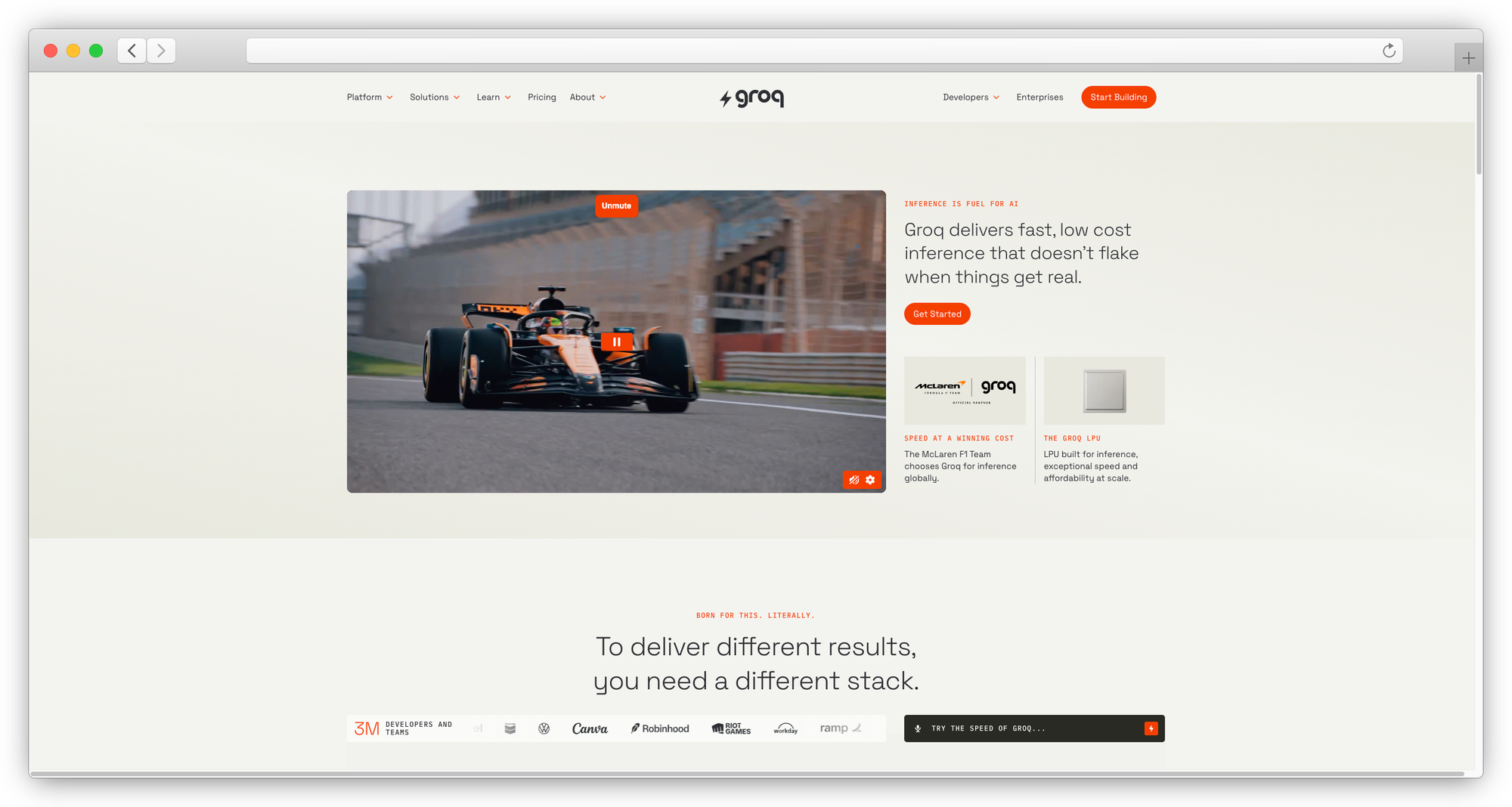
Groq built custom Language Processing Units (LPUs) from the ground up for AI inference. The result: Llama 2 70B at 300 tokens per second, 10x faster than NVIDIA H100 clusters. Recognized as 2025 Gartner Cool Vendor in AI Infrastructure.
Why enterprises pick it:
- Sub-millisecond latency impossible on GPUs
- Deterministic execution: performance doesn't degrade at scale
- 2.5M+ developers on GroqCloud
- Enterprise customers: Dropbox, Volkswagen, Riot Games
- Meta partnership for official Llama API (April 2025)
Deployment & Compliance:
GroqCloud API for most users. On-premise available but costs millions. Data centers in US, Canada, Europe, Middle East. Enterprise agreements provide dedicated capacity.
Pricing:
- Pay-per-token through GroqCloud
- Llama 3.1 70B: competitive with other inference providers
- On-premise: Reserved for large enterprises (multi-million dollar commitments)
- Free tier with rate limits for development
Best for: Real-time applications where latency defines user experience. Voice AI, conversational agents, customer service automation. High-throughput workloads where GPU batching creates unacceptable delays.
The catch: Limited model selection compared to general-purpose platforms. LPU hardware is inference-only, no training. On-premise costs restrict it to large corporations. Free and standard tiers have strict rate limits. Struggles with sparse models or dynamic computation patterns.
8. Fireworks AI

Production inference platform. Fine-tuning built in. Enterprise customers at scale.
Founded by PyTorch veterans from Meta, Fireworks raised $250M at a $4B valuation in October 2025. Customers include Samsung, Uber, DoorDash, Notion, Shopify, and Upwork.
Why enterprises pick it:
- 4x higher throughput than open-source inference solutions
- 30-50% latency reduction for customers
- Fine-tuning with continuous evaluation and reinforcement learning
- 200+ open-source models available
- SOC 2 Type II, HIPAA compliant
Deployment & Compliance:
Serverless API or dedicated deployments. Models hosted without hardware configuration. AWS integration. Customer data isolation with enterprise-grade security.
Pricing:
- Pay-per-token, serverless
- Dedicated GPU deployments available
- Fine-tuning charged per GPU-hour
- No published enterprise pricing
Best for: Teams moving AI from pilot to production at scale. Organizations wanting model customization without infrastructure management. Developers needing multiple model options through one platform.
The catch: Steeper learning curve than simpler APIs. Users report needing a quickstart guide. Serverless model limits frustrate power users. Limited multimodal support compared to LLM-focused optimization. GPU supply constraints could affect availability.
9. Cohere

Enterprise RAG specialist. Semantic search. Deployment flexibility.
Cohere isn't chasing benchmark wars. They focused on what enterprises actually deploy: semantic search, RAG applications, and document understanding. Founded by a co-author of the original Transformer paper, the company crossed $100M ARR by May 2025.
Why enterprises pick it:
- Command R+ optimized for RAG with built-in citations
- 128K token context with multilingual support (100+ languages)
- Embed and Rerank models for semantic search pipelines
- Deploy in VPC, on-premise, or any major cloud
- Models run on as few as 2 GPUs
Deployment & Compliance:
Cloud-agnostic: AWS, Azure, Google Cloud, Oracle, or on-premise. SOC 2 Type II, HIPAA eligible. North platform bundles enterprise AI with governance controls.
Pricing:
Usage-based API. Enterprise plans with VPC deployment. Cheaper than OpenAI for retrieval-heavy workloads.
Best for: Enterprises building knowledge bases, semantic search, or document analysis. Finance, healthcare, and government where deployment flexibility matters.
The catch: Models don't match GPT-4o or Claude on general benchmarks. TechCrunch noted Cohere's models "have fallen behind state-of-the-art" in raw performance. Limited multimodal capabilities. If you need cutting-edge reasoning, look elsewhere.
10. Perplexity AI

AI search with citations. Research workflows. Real-time information.
Perplexity combines search and LLM capabilities, delivering answers with sources rather than links. Valued at $20B in 2025, it's positioned as a research-first alternative to both traditional search and chatbots.
Why enterprises pick it:
- Every response includes source citations
- Real-time web access for current information
- Multiple model options: GPT-5, Claude 4.0, Sonar (proprietary)
- Enterprise Pro: SOC2 Type II, SSO, data retention policies
- Deep research mode for complex queries
Deployment & Compliance:
Cloud only through Perplexity's platform. Enterprise Pro tier adds security controls. Customer data not used for training. Team management and audit capabilities.
Pricing:
- Free: Limited searches
- Pro: $20/month
- Enterprise Pro: $40/user/month ($400/year)
- Enterprise Max: $325/month for expanded limits
Best for: Research-heavy workflows. Teams needing verified, sourced information. Analysts, lawyers, journalists who need citation trails.
The catch: Not a general-purpose AI platform. Limited customization options. Can't access internal company data. Struggles with multi-step work across sessions. Can't switch LLMs per thread. Not designed for AI agents or workflow automation.
11. IBM Watsonx

Enterprise AI governance. Not a chatbot. Build, deploy, govern at scale.
Watsonx isn't a ChatGPT alternative in the traditional sense. It's an AI development and governance platform for organizations building their own AI products. Think infrastructure, not interface.
Why enterprises pick it:
- AI governance built in: model lifecycle management, bias detection, audit trails
- Train on your proprietary data
- Integration with IBM's enterprise ecosystem
- Granite models for specific industries (financial services, healthcare)
- Runs on-premise, hybrid, or IBM Cloud
Deployment & Compliance:
Highly configurable: on-premise, IBM Cloud, hybrid, or third-party clouds. Built for regulated industries. FedRAMP, HIPAA, SOC 2 available depending on deployment.
Pricing:
Enterprise contracts only. No self-serve pricing. Based on deployment configuration, compute, and support level.
Best for: Large enterprises building AI into internal tools and processes. Regulated industries needing governance-first platforms. Organizations with existing IBM relationships.
The catch: Not user-facing AI. Complex implementation requiring significant resources. Aimed at enterprises with dedicated AI teams, not plug-and-play. Expensive for smaller organizations. Less cutting-edge than pure-play AI labs on model capabilities.
12. Azure OpenAI

OpenAI models with Microsoft compliance wrapper.
Azure OpenAI gives you GPT-4, GPT-4o, and other OpenAI models through Microsoft's enterprise infrastructure. Same capabilities, wrapped in Azure's compliance and identity management. For Microsoft shops, it removes friction of managing separate AI vendors.
Why enterprises pick it:
- Full access to OpenAI's latest models (GPT-4o, GPT-5 series)
- Azure AD integration, RBAC, private endpoints
- Data stays in your Azure tenant, not used for training
- 99.9% SLA with service credits
- Regional deployment options
Deployment & Compliance:
Runs in Azure regions you select. SOC 2, ISO 27001, HIPAA, FedRAMP certified through Azure. Fine-tuning available with temporary data relocation to centralized processing.
Pricing:
- GPT-4o: ~$5/M input, $15/M output
- GPT-4 Turbo: ~$10/M input, $30/M output
- Quotas per region, per model, per deployment
Best for: Microsoft-centric enterprises. Organizations already in Azure compliance frameworks. Teams wanting OpenAI without another vendor relationship.
The catch: You inherit OpenAI's model limitations plus Azure's complexity. Capacity constraints hit Azure hard, with CFO Amy Hood admitting "we have been short power and space." Quota management across regions confuses even experienced Azure users. Fine-tuning terms reveal data may temporarily leave your selected geography.
13. AWS Bedrock

Multi-model access. AWS ecosystem integration. Governance at scale.
Bedrock isn't a single model. It's a gateway. Access Claude, Llama, Mistral, Cohere, and Amazon's Titan models through one API. For organizations deep in AWS, Bedrock removes overhead of managing multiple AI vendor relationships.
Why enterprises pick it:
- Single API for 30+ foundation models
- IAM-based access control (no API keys to manage)
- Cross-region inference for automatic failover
- AgentCore for deterministic policy enforcement
- Knowledge Bases for managed RAG
Deployment & Compliance:
AWS regions only. Inputs and outputs not used for model training. FedRAMP, HIPAA, SOC 2 certified through AWS. AgentCore Gateway enforces policies outside the LLM reasoning loop.
Pricing:
Pay-per-token for each model. Pricing varies by provider. No commitment required. Provisioned throughput available.
Best for: AWS-native organizations. Teams wanting model optionality. Enterprises building AI agents with governance requirements.
The catch: Aggressive throttling frustrates scaling teams. New AWS accounts get severely limited quotas (as low as 2 rpm for Claude 4.5 Sonnet) while older accounts get 200+ rpm. Knowledge Bases feel rigid for complex retrieval. Missing OpenAI models entirely. Rate limit errors growing since late 2024.
How to Evaluate OpenAI Alternatives [FAQs]
Skip the feature matrices.
Ask these questions:
1. Where does your data need to live?
Regulated industry? GDPR requirements? Government contracts? Self-hosted options (Prem AI, Llama, Mistral open-weights) give you control. API providers require trust in their data handling.
2. What's your ML engineering capacity?
Self-hosted LLMs save money but cost engineering time. If your team has ML ops expertise, Llama or Mistral open-weights unlock savings. If not, managed APIs remove operational burden.
3. How predictable is your usage?
High-volume, predictable workloads favor self-hosted deployment. Bursty usage suits pay-per-token APIs. Run the math on actual token consumption.
4. What's your existing cloud?
AWS shop? Bedrock removes friction. Microsoft environment? Azure OpenAI integrates cleanly. Google Workspace? Gemini works natively. Fighting your existing infrastructure adds hidden costs.
5. What accuracy level do you actually need?
Not every task needs frontier reasoning. Document classification? Llama handles it cheaply. Complex multi-step reasoning? Claude or GPT-4o justify the premium.
The Bottom Line
There's no universal best OpenAI alternative. The right choice depends on your data requirements, cloud environment, engineering capacity, and budget.
For full sovereignty: Prem AI puts you in control of everything.
For reasoning quality: Claude leads benchmarks with strong governance.
For Google shops: Gemini's Workspace integration is unmatched.
For cost control: Llama and Mistral eliminate per-token fees.
For ultra-fast inference: Groq's LPU architecture delivers sub-millisecond latency.
For production scale: Fireworks AI handles enterprise workloads for Samsung, Uber, and Shopify.
For RAG applications: Cohere built their platform around retrieval.
For research: Perplexity delivers cited, sourced answers.
For AI governance: IBM Watsonx provides enterprise-grade lifecycle management.
For Azure/AWS: Use what you have. Integration benefits outweigh marginal model differences.
Start with your constraints.
Building AI that stays within your infrastructure? Explore Prem Studio for enterprise fine-tuning and deployment.