
7 Best AI Platforms for Financial Services: Compliant & Enterprise-Ready (2026)
Compare 10 AI platforms for financial services. Covers FINRA compliance, EU AI Act requirements, on-premise deployment, and model governance for banks and insurers.
AI platforms for financial services must clear regulatory bars that other industries ignore. FINRA's 2026 Oversight Report explicitly addresses agentic AI systems in brokerage workflows. The EU AI Act classifies credit scoring and fraud detection as high-risk applications requiring bias testing, documentation, and human oversight. Building AI for finance means building for auditors first.
This guide covers AI platforms that financial institutions actually deploy in production. We evaluated each on regulatory compliance certifications, deployment flexibility (cloud vs. on-premise), audit trail capabilities, and model governance features.
What Financial Services AI Requires
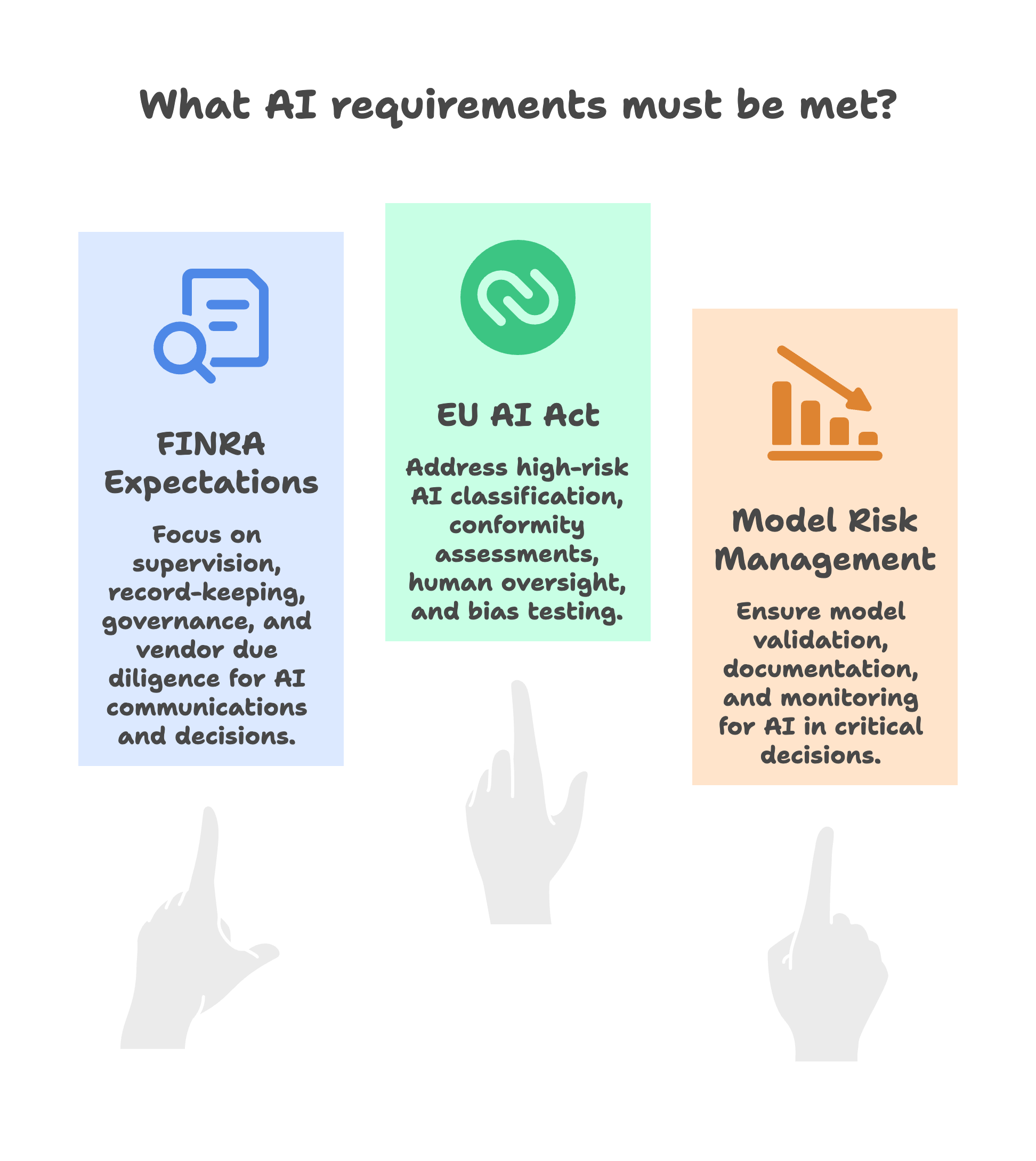
Before comparing platforms, understand what regulators expect:
FINRA expectations (2026):
- Supervision requirements apply to AI-generated communications
- Books-and-records obligations extend to AI decision outputs
- Governance frameworks must cover agentic AI that takes autonomous action
- Vendor due diligence for mission-critical AI systems
EU AI Act requirements:
- High-risk classification for credit scoring, fraud prevention, AML systems
- Conformity assessments before deployment
- Human oversight and intervention capabilities
- Bias testing and documentation
Model Risk Management (OCC/Fed/FDIC):
- Model validation for AI used in critical decisions
- Documentation of model logic and data dependencies
- Ongoing monitoring for model drift
The platforms below address these requirements to varying degrees.
Quick Comparison: AI Platforms for Financial Services
| Platform | Best For | On-Premise | Compliance Focus | Primary Use Cases |
|---|---|---|---|---|
| IBM watsonx | Governance-first AI | Yes | EU AI Act, MRM | Fraud, credit risk, compliance |
| Prem AI | Data sovereignty | Yes | SOC 2, HIPAA, GDPR | Custom models, fine-tuning |
| Microsoft Azure AI | Integrated enterprise | Hybrid | SOC 2, PCI DSS | Contact centers, KYC, fraud |
| AWS Bedrock | Scalable infrastructure | Cloud | FINRA-ready | Agentic AI, claims automation |
| Palantir Foundry | Data integration | Yes | AML, KYC | Cross-system analytics |
| SymphonyAI Sensa | Financial crime | Yes | AML, sanctions | Transaction monitoring |
| Dataiku | Collaborative ML | Yes | Model governance | Risk analytics, forecasting |
| DataRobot | AutoML deployment | Yes | Model validation | Credit scoring, fraud |
| Kensho (S&P) | Financial data | Cloud | Data provenance | Research, transcription |
| Self-Hosted (DIY) | Maximum control | Yes | Custom | Proprietary models |
1. IBM watsonx
Best AI platform for financial services requiring model governance
IBM's watsonx platform leads on AI governance for regulated industries. The platform provides compliance obligations-to-controls mapping that automates identification of regulatory requirements and validates adherence against existing governance documents.
Platform components:
- watsonx.data: Lakehouse architecture for data across core banking, claims, trading, and compliance systems
- watsonx.ai: Build fraud models, credit risk scoring, claims triage, and contact center copilots
- watsonx.governance: Model lifecycle oversight aligned to banking MRM standards and AI regulations
Compliance capabilities:
- Global compliance data covering EU AI Act, NIST AI RMF, and ISO 42001
- Risk governance at each stage: development, deployment, production
- Audit trail generation for regulatory examinations
- Model risk management aligned to OCC/Fed/FDIC expectations
Deployment: Available on-premises and as cloud service. Built on Red Hat OpenShift for hybrid deployment flexibility.
When to choose IBM watsonx:
- Organizations with existing IBM infrastructure
- Institutions requiring explicit EU AI Act compliance mapping
- Banks needing audit-ready governance documentation
2. Prem AI
Best for data sovereignty with enterprise compliance
Prem AI provides the compliance infrastructure that DIY self-hosted deployments lack. Swiss-based with $19.5M in funding, the platform offers SOC 2 Type II, HIPAA, and GDPR certifications out of the box. For financial institutions that need custom models but can't justify building compliance frameworks from scratch, Prem AI fills the gap.
Why financial services choose Prem AI:
Financial institutions face a specific challenge: they need custom models trained on proprietary data (trading strategies, risk models, compliance workflows) but can't use cloud platforms due to data sensitivity. Building compliant self-hosted infrastructure takes 12+ months. Prem AI provides certified infrastructure immediately.
Compliance certifications:
- SOC 2 Type II (annual third-party audits)
- HIPAA compliant with BAA available
- GDPR compliant with data residency controls
- Swiss jurisdiction under Federal Act on Data Protection (FADP)
- Cryptographic verification for every model interaction
- Zero data retention architecture
Platform capabilities:
- Fine-tuning: Train custom models on proprietary trading data, compliance documents, or risk datasets. 30+ base models including Llama, Mistral, Qwen. No ML engineering required.
- Autonomous training: Run up to 6 concurrent experiments with automated hyperparameter optimization
- Evaluation: LLM-as-a-judge scoring and side-by-side comparisons before deployment
- Deployment: AWS VPC, on-premise, or air-gapped options
Financial services use cases:
- Custom compliance models trained on internal policies
- Trading strategy assistants that never expose proprietary logic
- Risk models fine-tuned on historical portfolio data
- Client communication AI aligned to house style
Production deployment: Grand (Advisense subsidiary serving 700 financial institutions) uses Prem AI for compliance automation. The platform processes 10M+ documents securely across 15+ enterprise clients with zero data leaks.
When to choose Prem AI:
- Institutions needing custom models with enterprise compliance
- Banks requiring Swiss jurisdiction or EU data residency
- Organizations wanting fine-tuning without building ML infrastructure
- Teams that need audit-ready documentation from day one
3. Microsoft Azure AI
Best for Microsoft enterprise ecosystems
Azure gains favor in US regulated sectors due to enterprise integration and certified compliance models. Financial services institutions using Microsoft 365, Dynamics, or Azure already benefit from unified identity, security, and compliance controls.
Financial services capabilities:
- Contact center AI with compliance logging
- Know-your-customer and counterparty analysis
- Fraud detection and content generation
- Azure OpenAI Service with data protection controls
Compliance features:
- SOC 1 and 2, PCI DSS, GDPR certifications
- Financial services-specific regulatory frameworks
- Agent 365 as unified governance layer for enterprise agents
- Explainability features for model predictions
Platform insight (Microsoft 2026): 40% of financial services organizations are currently in the "implementing" phase of AI adoption. The sector has the highest concentration of "Frontier Firms" embedding AI agents across workflows.
When to choose Azure AI:
- Institutions with Microsoft enterprise agreements
- Teams wanting integrated identity and compliance controls
- Organizations requiring SOC 2 and PCI DSS certification
For teams evaluating cloud vs self-hosted deployment, Azure offers hybrid options through Azure Stack.
4. AWS Bedrock
Best for agentic applications at scale
AWS Bedrock serves financial institutions ready to move from pilot to production-scale AI. At re:Invent 2025, AWS highlighted financial institutions advancing mission-critical workloads and agentic AI with guardrails for regulated industries.
Agentic AI for finance: AWS emphasizes that institutions with data already migrated to AWS can build agentic applications on secure infrastructure with governance frameworks required for regulation.
Production example: Allianz Technology implemented multi-agent claims processing that reduced processing time by 80%. Seven specialized agents handle coverage verification, fraud detection, and automated payouts with audit trails for regulatory compliance.
Platform features:
- Access to foundation models from Anthropic, Meta, Mistral, and others
- Guardrails for responsible AI deployment
- Knowledge bases for RAG with enterprise data
- Agents for orchestrating multi-step workflows
When to choose AWS Bedrock:
- Institutions with existing AWS infrastructure
- Teams building agentic workflows for claims or operations
- Organizations wanting managed scaling without infrastructure overhead
5. Palantir Foundry
Best for enterprise data integration
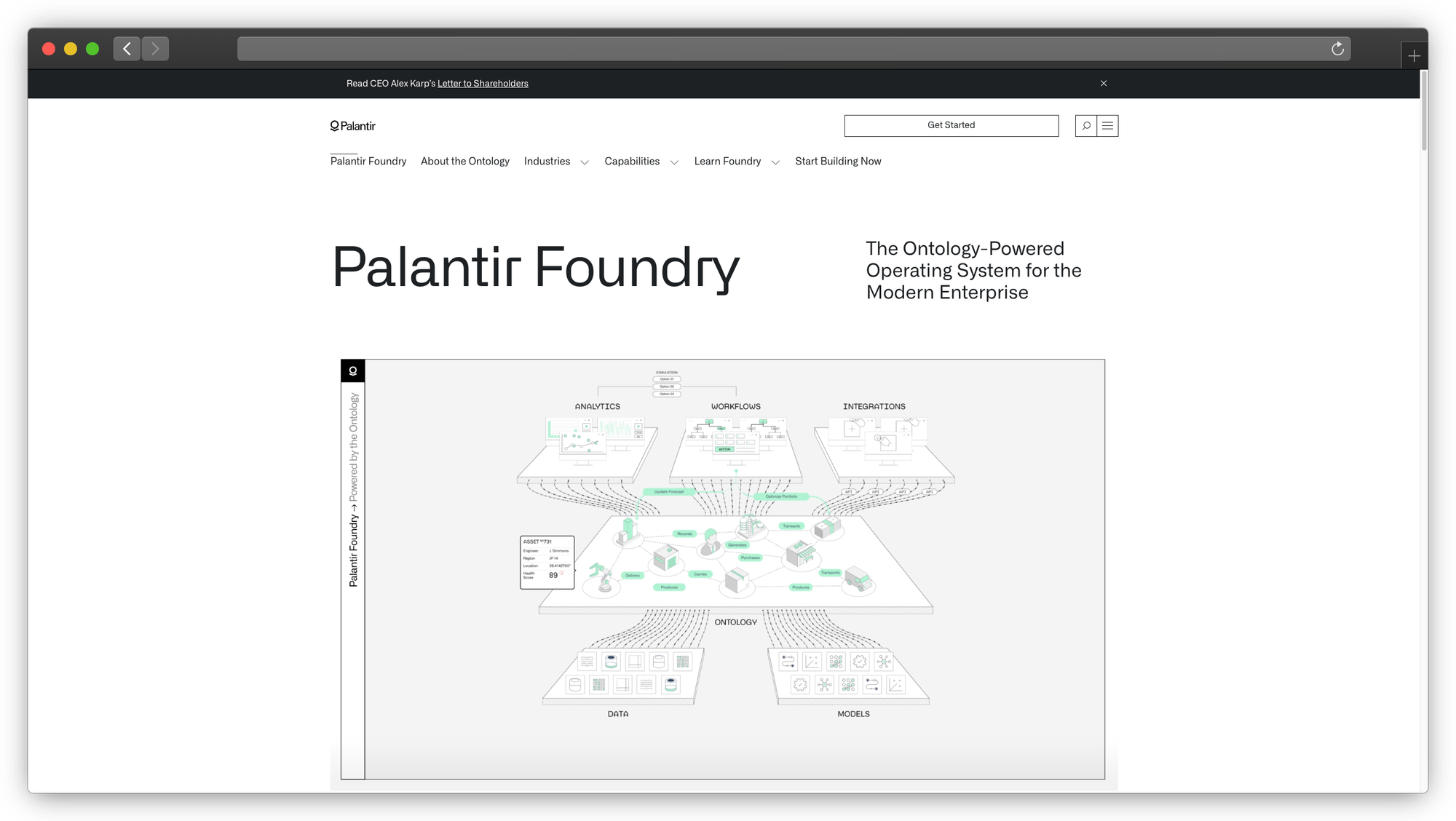
Palantir's Foundry addresses financial services' core challenge: fragmented data across dozens of systems spanning CRM, loan origination, servicing, risk, and compliance. The platform integrates, cleanses, and contextualizes data for real-time intelligence.
2025 deployments:
- Citi: Strategic partnership for enhanced onboarding, personalized investment advice, and real-time analytics for relationship managers
- Société Générale: Anti-financial crime operations with automated detection, improved case management, and reduced false positives
Joint venture (March 2025): TWG and Palantir formed a joint venture targeting AI deployment across compliance, customer expansion, operational efficiency, fraud detection, risk monitoring, credit processes, and lending activities.
Financial crime capabilities:
- AML transaction monitoring
- Sanctions screening
- Case management automation
- False positive reduction
When to choose Palantir:
- Large institutions with complex, siloed data environments
- Organizations prioritizing data integration over model development
- Banks requiring enterprise-wide analytics layer
6. SymphonyAI Sensa
Best AI platform for financial services focused on AML and financial crime
Symphony AyasdiAI's Sensa platform identifies hidden money laundering and financial crimes by uncovering complex data patterns. The platform serves banks, insurers, and asset managers with specific compliance use cases.
Core capabilities:
- Transaction monitoring with pattern detection
- Sanctions screening automation
- Mortgage fraud prevention
- KYC process optimization
- Liquidity optimization
Technical approach: Sensa uses unsupervised machine learning to find anomalies without requiring labeled training data. This matters for detecting novel fraud patterns that supervised models miss.
Deployment: Available for on-premise installation, addressing data sovereignty requirements for institutions that cannot use cloud-based AML systems.
When to choose SymphonyAI:
- Institutions focused primarily on financial crime compliance
- Banks with high false positive rates in existing AML systems
- Organizations needing unsupervised anomaly detection
7. Dataiku
Best for collaborative ML teams
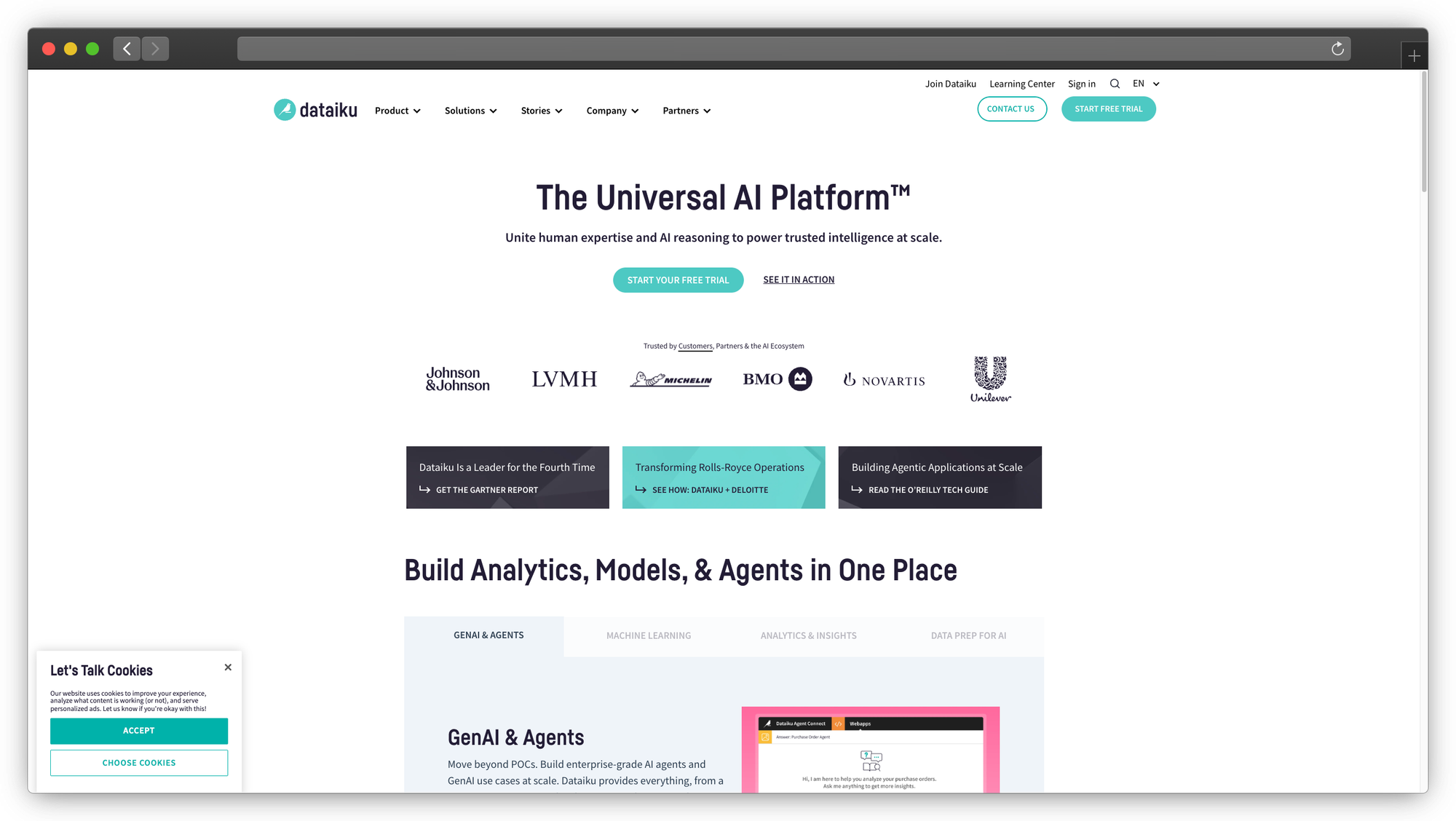
Dataiku serves financial services teams that need collaboration between data scientists, analysts, and business users. The platform emphasizes that successful 2025 deployments stopped building AI tools in isolation and instead co-designed with wealth managers, compliance officers, and risk analysts.
Financial services focus areas:
- Risk analytics and forecasting
- Regulatory reporting automation
- Customer analytics and segmentation
- Operational efficiency optimization
Governance features:
- Model documentation and lineage tracking
- Version control for models and datasets
- Role-based access controls
- Deployment monitoring and alerting
When to choose Dataiku:
- Organizations with mixed technical/business teams
- Institutions needing collaborative model development
- Banks wanting visual workflow design with code flexibility
8. DataRobot
Best for AutoML deployment
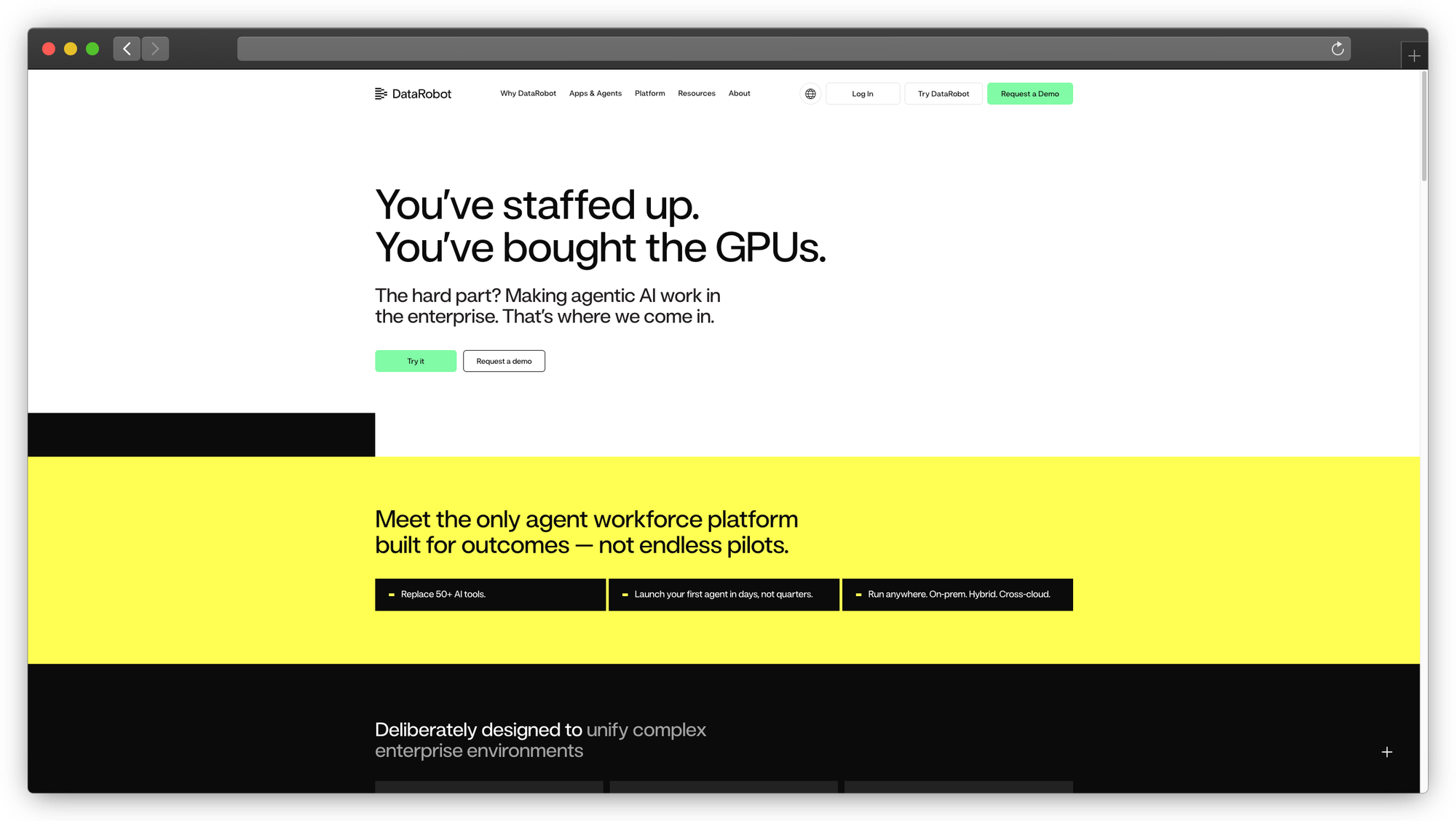
DataRobot enables financial organizations to build, deploy, and govern predictive models at scale. The platform is widely used across banking, insurance, and capital markets for fraud detection, credit risk assessment, and regulatory compliance.
AutoML for finance:
- Automated feature engineering
- Model selection and hyperparameter tuning
- Explainability reports for model predictions
- Champion/challenger model comparison
Use cases:
- Credit scoring with bias detection
- Fraud detection models
- Financial forecasting
- Regulatory compliance automation
Governance: DataRobot includes model monitoring, drift detection, and compliance documentation. Models can be validated against regulatory requirements before deployment.
When to choose DataRobot:
- Institutions wanting AutoML without deep ML expertise
- Organizations requiring rapid model iteration
- Banks needing explainability for credit decisions
9. Kensho (S&P Global)
Best AI platform for financial services focused on financial data
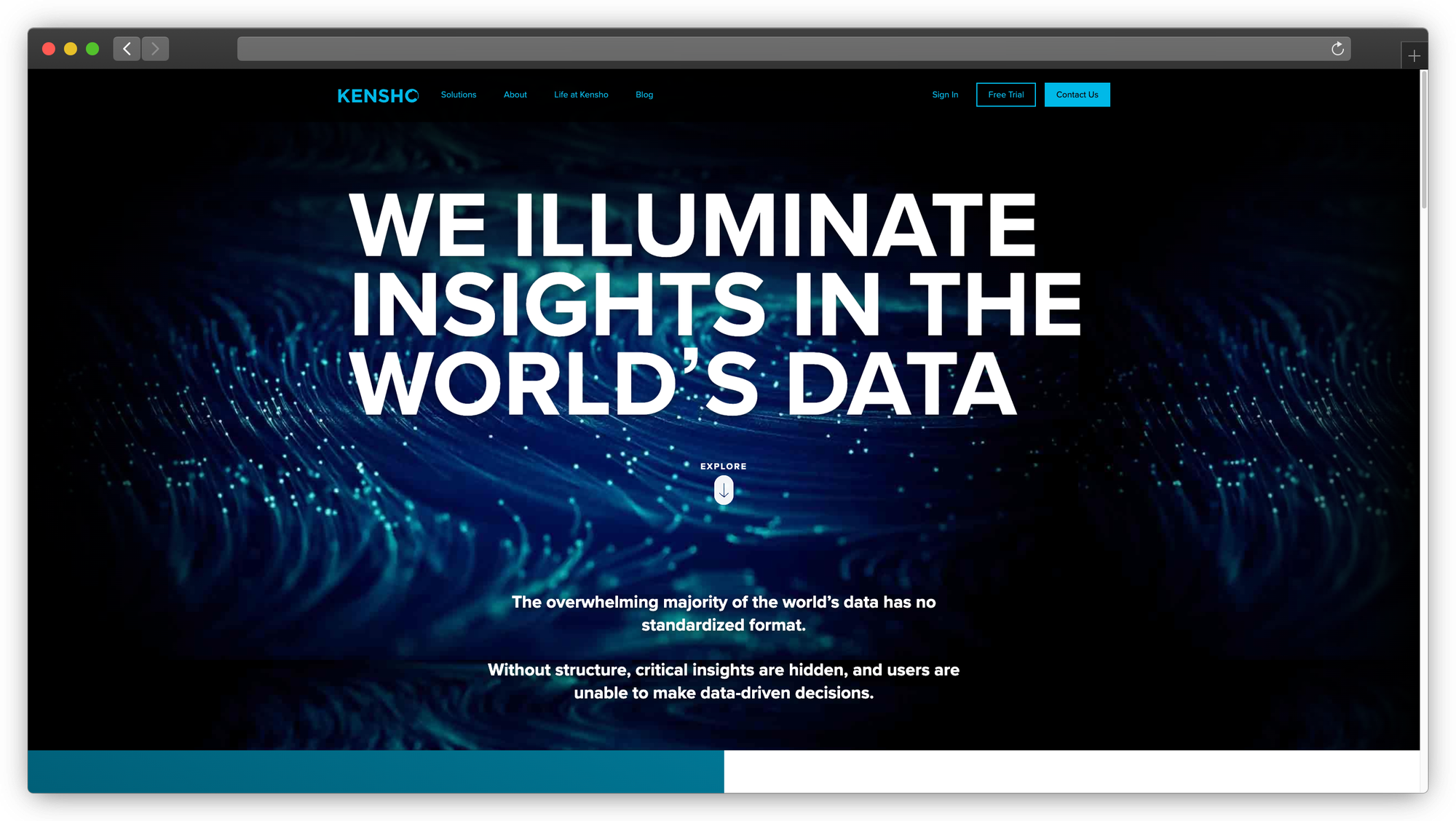
Kensho serves as S&P Global's AI innovation hub, providing tools specifically designed for financial analysis and research. Unlike general-purpose platforms, Kensho optimizes for financial domain tasks.
Platform tools:
- Scribe: Financial audio transcription (earnings calls, investor meetings)
- NERD: Named entity recognition for financial documents
- Extract: PDF to analyzable data conversion
- LLM-ready API: Integration with Claude for Finance for AI-powered answers grounded in S&P Global data
Why financial focus matters: General LLMs hallucinate financial data. Kensho grounds responses in validated financial datasets, reducing risk for institutions that cannot tolerate incorrect numbers.
When to choose Kensho:
- Research teams needing financial document processing
- Analysts requiring earnings call transcription
- Organizations wanting AI grounded in authoritative financial data
10. Self-Hosted: Building with Maximum Control
Best approach for institutions building proprietary AI capabilities
Some institutions cannot use any third-party platform regardless of compliance certifications. Proprietary trading algorithms, classified government contracts, or board-mandated data policies may require complete in-house control.
Self-hosted architecture components:
- Inference: vLLM or TGI serving open-weight models
- RAG: Vector databases like Qdrant or Milvus with local embeddings
- Orchestration: LangGraph or custom workflows
- Evaluation: Testing frameworks for model quality
Trade-offs: Self-hosting provides maximum control but requires infrastructure expertise. Teams must handle model updates, security patches, scaling, and compliance documentation independently. Budget 12-18 months for building production-ready infrastructure with proper governance.
When to choose self-hosted:
- Institutions with existing ML infrastructure teams
- Organizations with proprietary models they cannot expose to any third party
- Banks with board-mandated complete data isolation
Compliance Requirements by Use Case
Different applications trigger different regulatory obligations:
| Use Case | Key Regulations | Required Capabilities |
|---|---|---|
| Credit Scoring | ECOA, EU AI Act (high-risk) | Explainability, bias testing, adverse action notices |
| AML/KYC | BSA, FinCEN, EU 6AMLD | Transaction monitoring, SAR filing, audit trails |
| Trading Algorithms | SEC Rule 15c3-5, MiFID II | Pre-trade risk controls, market manipulation detection |
| Customer Communications | FINRA 2210, TCPA | Supervision, recordkeeping, consent management |
| Claims Processing | State insurance regulations | Documentation, human review triggers, appeals |
| Advisory Services | Investment Advisers Act, MiFID II | Suitability documentation, conflict disclosure |
Platforms vary in how they address these requirements. IBM watsonx and Microsoft Azure provide compliance mapping; Prem AI provides certifications; others require custom implementation.
Implementation Considerations
Start with governance, not capabilities: FINRA's 2026 report emphasizes that firms should move from experimentation to disciplined implementation with clear governance, robust supervision, disciplined testing, and comprehensive documentation. Build the governance framework before scaling AI deployment.
Human-in-the-loop is not optional: A key regulatory lesson from 2025: compliance responsibility cannot be delegated entirely to AI. Build human oversight mechanisms into every critical workflow.
Model validation applies to AI: OCC, Federal Reserve, and FDIC model risk management expectations apply to AI and ML. Validate models and document controls just like traditional models.
Vendor due diligence matters: FINRA expects initial and ongoing due diligence of vendors supporting mission-critical systems. Maintain detailed inventories of vendor services, the data they access, and GenAI-related contract restrictions.
Document everything: Audit trails are not optional features. Every AI decision in a regulated workflow needs logging for regulatory examination.
Decision Framework
By organization size:
| Size | Recommended Approach | Why |
|---|---|---|
| Large banks ($50B+) | Palantir, IBM watsonx | Data integration, governance at scale |
| Regional banks | Azure AI, AWS Bedrock | Managed compliance, integration |
| Community banks | DataRobot, Dataiku | AutoML, lower overhead |
| Fintechs | AWS Bedrock, Prem AI | Agility, cost optimization, compliance |
| Asset managers | Prem AI, Kensho | Custom models, financial data |
By primary use case:
| Use Case | Top Choices |
|---|---|
| Financial crime/AML | SymphonyAI Sensa, Palantir |
| Credit risk | DataRobot, IBM watsonx |
| Customer service | Azure AI, AWS Bedrock |
| Research/analysis | Kensho, Dataiku |
| Custom models with compliance | Prem AI, IBM watsonx |
| Proprietary trading AI | Self-hosted, Prem AI |
Conclusion
AI platforms for financial services require more than technical capability. Regulatory compliance, audit trails, and governance frameworks determine which platforms institutions can actually deploy.
The platforms covered here represent different approaches:
- IBM watsonx leads on governance and compliance mapping
- Azure AI and AWS Bedrock offer cloud scale with managed compliance
- Palantir solves data integration across complex institutions
- SymphonyAI specializes in financial crime detection
- Dataiku and DataRobot enable collaborative ML with governance
- Kensho grounds AI in authoritative financial data
- Prem AI provides enterprise compliance for custom model development
- Self-hosted options provide maximum data control
For most institutions, the choice depends on existing infrastructure (AWS vs. Azure vs. hybrid), primary use case (AML vs. credit vs. trading), and governance requirements (EU AI Act exposure, FINRA supervision scope).
Start with governance frameworks. Then select platforms that fit your compliance architecture.
What to Read Next
If you're evaluating deployment options:
- Cloud vs Self-Hosted AI - Decision framework for regulated industries
- Private LLM Deployment - Infrastructure guide for on-premise AI
If you're building AI governance:
- Enterprise AI Evaluation - Testing frameworks for production models
- LLM Observability - Monitoring and debugging in production
If you're exploring model options:
- Small Models for Enterprise - When smaller is better
- Fine-Tuning Guide - Customizing models for your domain